Saturday, August 29, 2009

Up with Arrested Development


They're back! The notorious Bluths and co. are heading to celluloid with the first film based on the critically acclaimed yet unappreciated Arrested Development sitcom. Apparently, the only holdout was Micheal Cera. I say this as a fellow Canuckistan-hoser: glad to have you back, Brampton boy!
I am definitely going to check this out!

Friday, August 28, 2009

How I Learned the English Language (A Poem)


I don't usually bother with posting my poetry, but I see no other place for my work right now. Tell me what you think:

How I learned the English language

I.
“No, you are making words,”
my mother said.
“Not just spelling with letters.”

The tiles did not help me.
I had the edge of a spine-damaged
board to fill with
a large set of consonants.

“Learn to spell it
in your head and study what’s there.
Make it fit.”

II.
“And which one is bigger?”
Some hands went up.
My arms stayed still.

“Is it this one or the other one I’ve drawn?”
In her glasses, I see myself
choosing the wrong figure.

Quarter, third or half:
Which one has the most letters?
Another failure in math.

III.
“My friend wants to know,”
said the girl who brought
strawberry-scented air,
“if you’ll go out with her.”

My homework was not done
and I could not see a face
in any corner of the floor.

The books gave me no advice in particular on what to do.

IV.
“That was amazing.
You can really write.”
Another reading and
my first vocal critic.

A smile cannot be unsmiled;
a look become unaimed.

Her boyfriend liked the poems, too.

V.
“Read me the bird story.”
A nephew’s demands were
better than anything I had heard that day.

I read it out, gave the characters
their own voices
(meow, caahs and whistles)

And I never did get tired of the book.
Not even when I could have been at work
with my own pen and the white space
of a too-clean page.

He often slept too soon,
and I just had to
close and wait for
his dreams to start.

Thursday, August 27, 2009

Sex With Superheroes


I wrote this for a magazine that was asking for lists of weird and esoteric thoughts. They, of course, rejected this outright.

This is just a brief guide to what to expect if you could have a relationship with certain comic book characters:

Superman – he is the Man of Steel; however, he is also faster than a speeding bullet

Batman – in good shape, but he would be selfish in bed; has to have all of those gadgets with him

Spider-Man – does whatever a spider can; could be creative with those web shooters

Wonder Woman – some bondage involved (with that rope, a lot of truth telling); interesting wardrobe, as well

Aquaman – comfortable in and out of the water (better stick to late-night romances in the pool, Jacuzzi or nearest lake or river; lubrication is important)

The Flash – far too fast; you’d never notice

Daredevil – extra sensitive with his other heightened senses (and he is The Man without Fear)

The Green Lantern – man in a mask with matching jewellery (draw your own conclusions, ladies)

The X-Men – an Uncanny group; they would be mostly generous about giving pleasure, especially Wolverine (Rogue might be a challenge)

The Fantastic Four – A married couple and two other men (one who keeps yelling “Flame On!” and the other one is called The Thing): kinky!

Tuesday, August 25, 2009

Are You Happy?


I am giving this blog entry the worst possible title. It is a question that no one likes to have thrown at them, especially at the beginning of the week and at the end of the summer. But it is on my mind. I found a quiz online that can test your level of happiness.
Tell me how you do and what makes you happy!

Sunday, August 23, 2009

2009 Canadian Eastern Regional Barista Championships


This was a good Sunday. I thought that it would be wrong to be so late to see baristas at work preparing different cups of coffee for the honour of being chosen Canada's best. How very wrong of me. I ended up at 2111 St. Laurent at the Just for Laughs museum after 2pm, just in time to see a new entry work his magic on a very fancy Nuova Simonelli machine. This was serendipity in action. I ended up sampling smoothies, four types of coffee, a few flavourful syrups and a free lunch. That was necessary with all of the caffeine in my system.

Now, what exactly am I talking about. This championship, from what I can gather, is a way for manufacturers, coffeemakers and distributors and others in the industry to get their name and product heard. It was also free, which meant that they did want the public to see what they had to offer. I saw parents with their childrens, couples who came in out of curiosity, and people who just wanted the buzz of another espresso or cappuccino.

It also made me think about our obsession with brands and styles of coffee. I sampled two coffees from Bolivia - Colonial Caranavi - and Ethiopia - Sidano - and noted the labels on the different urns. The two "mid-roast" drinks had a "light acidity", "full and heavy body" with a "caramel finish" (the former) and also a "pleasantly sweet" and "balanced acidity" with a "flowery smooth and wild berry finish" (the latter).

Pretentious, wouldn't you say? I guess the thing to do is develop a palette, as you would with wine or other alcohols.

I look forward to discovering more about this championship.

Thursday, August 20, 2009

Getting Served by St. Vincent


I fell. St. Vincent (AKA Annie Clark) performed at Montreal's Sala Rossa on Friday, August 7th and I was lucky enough to have a ticket for the show. The performance showcased her new album, Actor and material from her debut, Marry Me. I was also lucky enough to speak to her after the show and she was as friendly in person as she was fiery on stage (I will never forget her ripping through the Beatles' Dig a Pony - a solo showcase with electric guitar that should make P.J. Harvey and Jack White rethink their careers).
And now there is this. I found this link on Spinner, a great web site that you should check out. Miss Clark tore a new one on Lady GaGa, Lilith Fair, and the tendency of critics to lump female musicians together for the sake of convenience.
I am impressed and in love (like I said, I fell).
Enjoy!

Tuesday, August 18, 2009

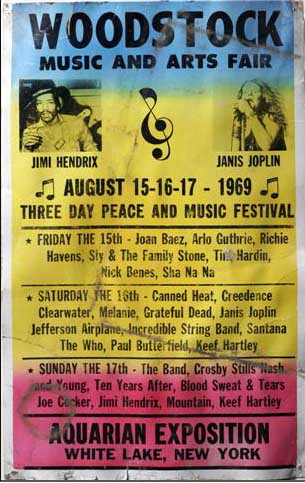
Back to the Mud: Woodstock at 40


Forty years ago this past week-end, a festival took place which was a perfect example of how not to run a festival. Tickets, around 160,000 of them, were sold, but there were no booths on site to collect them. The promoters had to convince the local state government to not send in soldiers to disperse the unexpected number of young people who appeared. Those same promoters would lose money and temporarily shut down the show beforehand. There were worries about expenses, sanitation and the possibility of mass electrocutions due to exposed cables in the gouged and muddy ground.

Ahh...Woodstock.

To invoke its name is to draw one to a particular time in the summer of 1969 when three days of music change the world. An older generation still looks on it with disbelief; a younger generation is often unable to imagine it ever took place. Too many of the big musical events of our present age - Live Aid I & II, Bonnaroo, Osheaga, etc. - have been tied into definite causes, or promoted and used as blatant commercial vehicules. This is not to say that none of the bands on Max Yasgur's farm were unaware of the exposure the show would provide, or that they were in it just for their fans. But there was clearly something untainted and optimistic about that time.

This is why I have a hard time believing it ever happened. Yes, I have seen the film. Yes, I have read books and seen photos. Boomers are often eager to talk about events from that decade. I am not doubting the mass gathering of people or the fiery performances of many of the bands. It just strikes me as odd that any number of human beings could get together like that without riots, violence and the threat of disease and jail time (perhaps Woodstock 1994 coloured my perceptions).

I mentioned commercialism. There was no product placement on stage or on the crowded roads heading to the farm. Many big names had decided to stay away - the Doors; Zappa and his Mothers of Invention; Dylan, who was living nearby; the Beatles, who had their own problems; and the Rolling Stones, who would lead the Age of Aquarius to a particular nadir at Altamont - but the ones that went on with the show will never be forgotten. The Who ripped through their classic singles and their just released rock opera Tommy; Alvin Lee with Ten Years After became a guitar god; Crosby, Stills, Nash and Young played their second show as a quartet that weekend; and Jimi Hendrix gave us a proper, up-to-date version of The Star-Spangled Banner.

I recently watched Santana's performance of Soul Sacrifice while flipping between stations during the film's airing on a art TV channel. And I finally got it: the day and the spirit could never be repeated again. I flipped past the Pussycat Dolls and Black-Eyed Peas doing their thing on video and noticed how they were both stomped and utterly forgettable next to the energy and spirit of Santana and company.

You may say that the festival may have spoiled musicians and record labels with the idea that the audience for music was much bigger than expected. They learned how to play a new game. But that one rare moment in the rain and mud deserves to be envied and looked on with awe.

Back to the garden, folks...

"I wish I had gone to Woodstock. That was a story." - Walter Cronkite

Sunday, August 16, 2009

Elvis Presley: Uncomfortable Icon


Thirty-two years ago this week, a singer died at his palatial home after spending most of his life as a performer who never understood the greed and ignorance of the industry which used him and barely comprehended his talent.
That is the melodramatic way to read the fall of Elvis Presley. In other quarters, it would sound like this: a dumb kid with a glorious voice and a wonderful ability to interpret any song he chose to sing became fat, drug-addicted and died in his bathroom from a combination of bad dietary and pharmaceutical habits which enlarged and damaged his already too-broken heart.
Yes, it is cold to read it that way on the page. But both interpretations contain their own truth. For those people who will spend this August 16th waiting in line to get into Graceland – memorabilia collectors, impersonators, desperate housewives and the just plain curious – the latter paragraph is blasphemy. They need their Elvis, no matter how distant and messed up the life they honour. They need their memories massaged and whatever love they can find restored.
And what is not to love? Elvis was a true performer; a man who loved to be out in front of the audience doing what he came to see as the most natural and untainted act of his overexposed life: singing. And he was born to sing. Listening to Elvis: 30 #1 Hits, it is hard not to have your ears seduced by this release of his chart-topping hits, even if you are like many critics of a particular generation and have never bothered to pick up a Presley recording in your entire life. Yes, he only (co-)wrote two songs (and was much more interested in gospel – his first love – as a musical idiom) but what he chose to cover became classics: Heartbreak Hotel, Don’t Be Cruel, Are You Lonesome Tonight?, All Shook Up, Love Me Tender, Suspicious Minds… The list feels endless and cannot be completely comprehensive.
As well, like any performer worth watching, Elvis knew his audience. His moves may not have been choreographed, but they came from a history of culture clashing as American as it was raw and unsettling. And this is where Elvis becomes a problematic figure. He reinterpreted and remade the moves, attitudes and behaviour of singers and music from different genres into something palatable for both white teenagers and the blue-rinse set.
Not that this was a plan. Again, it must be reiterated that Presley’s approach to music and performance did not come out of a meeting of business executives. His very presence as a performer in 1950s America altered the culture in such a way that the aftershocks still echo throughout the nation and beyond. When he was seen as a danger to the morals of youth, he was a gift. After his stint in the army, he returned to music, including more lamentable films and overlong touring schedules to his life. This turned him into another celebrity casualty. He became an uncomfortable image of all that America can do to those who do not conform while creating their art. He was tamed for all to enjoy.
The last thing that can be said about Elvis is the first thing that should be thought about him: it is impossible to imagine music from the last fifty years – roughly the moment when he joined RCA and became a commercial recording star – without his shimmering presence. Keep this in mind when you think about what it cost him. It is the true tragedy of the Presley story: he was never allowed to escape his own legend.

Thursday, August 13, 2009

Clare Torry and the Great Gig in the Sky


Clare Torry was one of the most important British vocalists of the early 70s. And you are forgiven for not knowing her name. This is fair. She was a session singer who never gained the fame of some of her contemporaries. But she was always there, adding her distinctive sound to various recordings. She would also become immortalized through a late-night session that no one predicted would last in the musical memories of so many fans.

Miss Torry sang with Olivia-Newton John, Alan Parsons Project and Meat Loaf in her work as a back-up vocalist. None of her own recordings became great hits, although there are compilations of her work that are worth listening to. It was a wet Sunday evening in 1972 that gave her a place in musical history. She was called into Abbey Road studios to add her voice to an instrumental track that a band had trouble completing. At first, it seemed as though the session would go nowhere. The band offered nothing but rejections when she gave standard interpretations with lyrics along the lines of “Baby, oh how I love you,” etc. It would take several sessions before Miss Torry hit upon the idea of turning her vocal performance into a completely emotional performance divorced from any discernable lyrics. Finally, the band felt satisfied with what it heard and sent her on her way. She went out to dinner with her boyfriend that night without any knowledge of how moving and important her contribution was until she saw the album on sale at a local record shop. Still, she had made her 30 pounds for the work.

That session had produced the immortal The Great Gig in the Sky, arguably the most moving track on Pink Floyd's The Dark Side of the Moon. Her wailing, cooing performance has been described as someone in an “orgasmic or terrified” emotional state. There is very little reason to make any sort of distinction between the two when considering the album’s themes of loneliness, longing, despair and paranoia. Miss Torry managed to encapsulate all of this with her vocal. And it was all her idea. Rick Wright's piano feels like it was added as an afterthought.

Oh, that 30 pounds would not do. Clare Torry would sue the band for copyright and a share of royalties on the song. From 2005 onwards, “The Great Gig in the Sky” would be credited as a Rick Wright/Clare Torry creation.

She must have the final word: “If it had been the Kinks, I would have been over the moon.”

Wednesday, August 12, 2009

Goodbye Mr Hughes


John Hughes, the cinematic Dickens of eighties suburban teenage life, died last week of a heart attack while walking through Manhattan early one morning. He was only 59 years old. That, of course, makes me feel old. I grew up with his work, as so many others have, and it feels like a large portion of my visual memory has been brought back to bear on movies that came far too close to the truth. And as uncomfortable as I feel doing so, I have to look back.
It starts with a poll. The Globe and Mail, Canada's national newspaper, ran a poll on the most popular John Hughes film. I chose The Breakfast Club; most of the World Wide Web chose Ferris Bueller's Day Off. How naive of me. I thought that the tale of a group of detentioneers discovering themselves and each others' foibles would be on top (it only received 16% of the vote). Ferris is the tale of a smart-ass kid who is always on top of things, always breaking the rules, and always getting away with it. It was almost too cartoonish a choice. But I understand why it came out on top (36% chose it).
1986 and I am twelve years old, waiting in line at the Odeon theatre to see the film in its first week (I still have a poster and button with the film's logo and Save Ferris written on it). I sit and watch. And then I just gape. I had never seen a film with a direct address to the audience. I had never seen a film with a direct address to a teenage audience (one which I was near enough to qualify for). I just could not believe that they got away with it. The only problem was I saw the film with my mom (hey, I was only twelve and had to go downtown to see it). It was the wrong choice of companion for a day at the movies.
I am serious about that. John Hughes understood a particular type of moment in life: the state of youthdom when things are becoming defined and hardened around you, and there is little you can do to change it. It would be hard to imagine him making a film about post-secondary life that followed these same type of characters. The director who made Sixteen Candles and Pretty in Pink does not seem to be the same one who made Uncle Buck or Planes, Trains and Automobiles. He found a space and occupied it well. I still feel like I was Anthony Michael Hall looking for that eternal Molly Ringwald who wanted nothing to do with me (like I said, he really understood adolescence, especially my own teenage life).
In the same paper, Globe and Mail writer Lynn Crosbie commented on how she felt a distance from the people on the film because of their age. I do admit that I sometimes felt the same way. There is something cynical and sweet, distant and perceptive in how Hughes draws you into his films while teasing his audience with the idea that the characters are who you are (esp. if you were white, middle-class and living in an area that looked remarkably like Chicago in every film).
But that is a critique that will fade and disappear as his films are reassessed, re-examined and remembered. We needed to have this type of filmmaker in 1980s America and I cannot imagine my moviegoing life without those stories.
Mr Hughes, I thank you.

Monday, August 10, 2009

Second Thoughts on a Second Skin


This will be a little chat about condoms, so I will try to bring a mature and sensitive voice to the following:

Sausage Wrappers have been around for just over two centuries, not quite as long as men and women have wanted to have them around, but long enough for a certain generation to avoid the responsibility imposed by unwanted pregnancies, proactive diseases and soon-to-be-less-than-attractive overnight partners. Sheep placentas were the first Meat Cocoons available; soon, modern technology began its long and intrusive interest in sex and reproduction. The new age of Rubber Rod Retainers began in earnest at the beginning of the twentieth century. This coincided with the appearance of the automobile, bobbed hair, short(er) skirts, the Jazz Age, bathtub gin, and a general sense of freedom that comes after surviving a world war and lethal pandemic; may as well have some fun while you can.

The Age of Aquarius – okay, that era from 1964 to 1973 – disowned most of the responsibility created by their parents and avoided Plastic Penis Packers for an ethos of free love, long hair, drug use and uncensored promiscuity. It was called The Sexual Revolution, a battle which left the bacilli victorious. By the eighties, disease became the main concern of any sexual partner who wanted to protect themselves and others with a Shrink-To-Fit Coat. The times changed and protection remained the same.

Or did it? From the names of these Synthetic Semen Stoppers, you could conclude that they are very pertinent and relevant to an age of determined and demanding consumers. First, there is Trojan. Yes, it is dated, but this is a rather wise choice of a name. It makes you think of not only a horse but also hidden danger. Then there is Lifestyles. Rather bland, but the specific brand names do speak of the possibilities available to lucky users. “Peace and Love,” “Natural Feeling” and – no pressure here – “Endurance” all speak for themselves. One of the oldest names in the business, Durex, still sounds like a planet Captain Kirk and his crew could have visited while boldly going where no one had gone before.

Then there are the Naughty Raincoats of other countries. The Japanese believe that men with large noses are also well-endowed below the waist. There is one company that goes so far as to put a large nose on specific boxes meant for the well-overhung. These particular Snake Jackets come with names like Jellia Coat and Honey, and they should not be used by wishful thinkers.

There is still the difficulty faced in buying some of these Boner Baggies with a straight face. The local drugstore seems far too hygienic and clean for a purchase. You should head out to the specialty shops, restrooms with the right vending machines, university/college campuses, and particular conferences and seminars (Montreal, Quebec's Salon de l’Amour et Seduction is always a good bet). The goods may be in our public eye, but not quite yet in our discourse. However, it seems that most sexually active people know what they want and how to get it. It may even be possible for men to buy a Baby Blocker without embarrassment.

But do they know not to call it a “rubber?”

Sunday, August 9, 2009

YouTube Etiquette


To understand the web, the only thing to do is to dive in and hope that you make it back to the surface. There are perils and joys to discover. The Internet is unique in that it can both reward and rob you at the same time. The world is at your nearest mouse click, but it eats up all of your time trying to find the next new thing. For any form of technology offering several billion pages of information, this is inevitable.
Of course, one of the most popular web pages out there is YouTube, a site that allows one to see amateur musicians, bad dancers, and almost-forgotten television programs which can now be enjoyed before they are pulled by the networks over copyright infringement laws. It has redefined what we can use the web for because it allows to the viewer to be a participant instead of the normally passive figure in front of a screen. And it is no surprise that television has lost viewers to the Internet. Why be a spectator when you can both play the game and coach yourself?
As with any new toy, there are those who are willing to abuse it. There are a lot of web pages and links that can offend, bore and just make you think that the best instincts of the World Wide Web community are perverse, predictable and just plain ugly. YouTube is just as guilty as any other page when it comes to this link of abuses. Think of the endless number of negative comments that are posted over a simple message; or the uploaders who have decided to get their messages heard by promising porn. Antagonism is rife and will not end without some sort of general understanding of how the site should be used.
With this point of reference, it is necessary to propose some rules of usage, a list of etiquette that should be applied to this page. It is not a list to start some sort of censorship, or self-censorship. A viewer already has the option to flag videos that they do not like or think are offensive. It is simply listed to show just how absurd things have become on the page that encourages you to Broadcast Yourself.
Let’s start with the names. Number one rule: Choose a decent handle for yourself, not something that reminds browsers of the already low standards of grammar on the web. jazzoholic works (it is witty, clever and speaks of two obsessions that often go hand in hand); whizzypoo does not (the reasons for this are obvious, in a scatological sense), and both are very real and very used names in the Comments section of the page.
Next: the comment itself. Please don’t quote lines from the clip that you and the rest of the surfers on the Web have just watched. Apart from the hearing-impaired viewers out there, people know what they have just seen. Leave comments that comment, not ones that repeat.
No more ads for porn web sites that do not offer anything for free; also, no more multiple ads for the same porn web site with one comment (doesn’t anyone understand the concept of diversifying?). Add to this the desire to straight-out porn on the regular YouTube site (and no more nonsense like using a sexy still shot for an upload of your drunken idiot friends pretending to act). If the web site's founders really want to compete, they should be giving YouPorn and xHamster a hard time (so to speak…)
Now, if you have made it to the web page and have become a subscriber, please learn a little about punctuation and spelling before leaving a comment. It simply looks better on the page if you get these things right instead of telling the world how much “yu lurv de chic wif the beeg nawbs”.
And this is a personal one: more information on the great Mentos/Diet Coke experiments. If you have not seen this in action, you should get onto the site right now and experience the joy of propulsion and carbonation in tandem with “the freshmaker”.
And then there is this: not in itself a bad thing, but please keep the lesbian kissing to a minimum. And tell the truth: most of those girls are not really lesbians and are providing the wrong sort of information to all of the lonely and horny teenage boys out there. Truth in advertising is a precious thing.
Now, about the comments on the comments: if someone receives more than five thumbs-down clicks, that is just wrong. They usually remain hidden, but it seems like overkill or abuse to see -15 next to the downward-turned digit just because someone doesn’t like a video. And don’t bother adding more and more negative written comments against one idiot you don’t like. This is distracting and perhaps a way of falling into a carefully-laid trap (there is no such thing as bad press).
Finally, the pulled videos: why do the networks do this? They hate the free advertising? The interest in their product is drawing people away the boob tube? No, it is all a question of money and advertising. So, here is what you can do: screw with them! Keep posting their clips, no matter how often they pull them down. Their writers were just on strike; maybe their viewers should join them.
YouTube is here and we have gotten used to it. We should know how to use it.

Saturday, August 8, 2009

A Trip to England


When I was fourteen, I was sent to visit part of my family in London, England. It was in the summer of 1988 and I do not know why I was sent at that particular time. We had just moved into a new house (this would be our last move after years of changing apartments and houses around the same city). Perhaps my mother felt that I would be used to another change in my location and had enough experience travelling to take such a trip. I had already seen parts of the Caribbean on different plane trips with my family and we had taken part in a long trip by car from our home to a friend’s place in California. The trip to England would be another stamp on my passport.
It was my mother’s decision, but she was not the only one who wanted a member of the family to travel and make contact with relatives that were known only from letters and phone calls. One of her close friends from work would be sending along her daughter, a girl only one year older than me. I had known her for about a year and was told that she would be staying with a different family once we arrived. So, she would not be keeping watch over me. Perhaps it was just practical for our mothers to be freed from us for that one summer. There must have been some sort of plan that they did not want to share with us until school let us out for a few months.
We travelled by ourselves. This is significant. I had never been on a plane without a member of my family and the trauma must have been quite pronounced in me. But what I remember most is what I wore on the flight. My mother had decided that I would have to look presentable before landing in England, so I wore grey pants, a pink dress shirt, and a pink and grey tie with paisley patterns on it. The colours matched but refused to please the eye. Any fear I had about being alone with the daughter of a family friend, or with an unknown relative in England was soon replaced by my annoyance at having to wear such clothing. I was overweight and itchy in that unflattering outfit. And the summer heat also played a predictable role in my discomfort. It seems more important now to think about how I was presented to people who were called family and had never met me before than to worry about the fear of being alone. My look set up a false impression that I could not match. I was happier in t-shirts and jeans. And I never wore that outfit again once during my stay.
I don’t remember much about the flight. The plane left from my hometown, Hamilton, Ontario. This seemed very strange to me; the airport on the city’s escarpment was known for air shows and its museum commemorating aircraft from the Second World War. It was not known for flights to other countries, and it was striking that there was no changeover in Toronto or New York. This saved time and money, not something that was on my mind. I only thought about how small my part of the world was and how happy I felt to be travelling. It would be six weeks – from early July to mid-August – and there would be no talk of summer school or day camp (they both seemed to be some sort of punishment). I would be living in London, the centre of the literature that I loved and the culture I knew from imports like Coronation Street, Doctor Who, numerous rock groups, and the general knowledge of a language that we mimic well in Canada, right down to the quirks of spelling and pronunciation. I thought I was well-prepared.
We landed at Heathrow Airport and I was quickly separated from my travelling companion by a group of women (we did not meet again during my stay). I met G. and her two identical brothers, K. and D., and D’s wife. We then made our way to the car as they asked questions about my flight. And then came the speeches. As we drove from the airport, and survived several near-accidents with the traffic and other obstacles (i.e. pedestrians), they began to tell me about their lives in London.
I should preface this next section by mentioning my and their West Indian backgrounds. England gave my ancestors a very difficult history, from slavery to certain political parties to bills in Parliament meant to strip them of the few rights they still had left. From the airport to the first stop – to drop off K., D. and D’s wife, I was told about how difficult it was to be black in that country. I will always remember one particular story about a friend who worked as a driver and ended up working in one of the many large offices we drove past. In case I thought that this was simply due to perseverance and hard work, they explained that this man only made it because the person he chauffeured liked his face.
I would be staying in G.’s apartment. She asked me if I wanted something to eat and we stopped at a small store to buy some food. I told her that I would like to make a submarine sandwich. I ended up with hard French bread (a baguette) and coleslaw. We then went to her place. This all took place in the east end of London in an area called Plaistow. She lived in a tall apartment complex near the area’s London Underground station. Her floor was dimly lit in the outer hallway and her apartment was needlessly cramped. There was her main bedroom, which I never entered; a bathroom; a very small wedge of balcony, the front room (where I would sleep on a fold-out couch); and a narrow kitchen. This was where I attempted to put together my sandwich as she looked on with wonder at my construction. It was during this meal that I made the mistake of looking around that kitchen. She had a gas stove, a small fridge and some of the dishes drying on a rack near a large window. The main cupboard was open and when I peered inside, I noticed several half-eaten packages of cookies, biscuits, breads, crackers, and chocolate bars. She apparently ate part of what she bought, forgot about it in that space, and then went out to buy a new package. I felt nauseous but I could not share this with G. She was allowing me to stay in her place for six weeks and I had no other available options.
Later that night, I woke up to G. yelling from her bedroom window at a man and a woman on the street. The couple had just left a pub and was now engaged in a drunken fight on the pavement. G. encouraged the woman to “knee him in the groin, dear” and the man responded by calling G. a bitch.
And that was my first day in England.

*

It is hard for me to accept how naïve I was about life in London, even at the age of fourteen. I unpacked my bags and filled up her front room with my collection of music tapes. This was my first mistake and a sign that I did not know the culture I was in. I was listening to mostly progressive or light rock (Genesis and Supertramp were personal favourites). My mistake was sharing this so publicly. I had a Walkman, but I sometimes insisted on playing these records on her stereo. What I mean by saying this is that I did not understand the culture I was in and that I was out of step with what I thought I knew from those exports I mentioned (most of my recordings were made by British groups and record companies).
Even my sense of comedy was a problem. The British have mastered this particular type of entertainment and should be proud of their skills in self-parody and finding the humour in their worst moments. But most of my relatives, including G., could not fathom my love of Monty Python’s Flying Circus or the routines of Dave Allen. The former, now as much an institution as any of the other British programs I watched in Canada, was too difficult for them to follow; and the latter was just a dirty old man who had managed to have a career through his seediness. I was alone in my interests.
There was something very fortunate in being forced to become self-reliant. G. had to work for most of my stay, and since we did not see eye-to-eye on most issues – food, music, other entertainment, etc – I learned to be alone. She made sure that I had a pass for the Underground and I learned to travel around London by myself. We never travelled together on this public transport. I was a solitary tourist with my maps and some blind luck. I saw Hyde Park, Paddington Road, Baker Street, Piccadilly Circus and the Royal Albert Hall. And I can now admit that most of those names did not mean anything to me at the time. I knew a little about those places as landmarks; my information came to me second-hand and indirectly. Paddington Bear was a cartoon that mentioned Piccadilly Circus; the Beatles name-dropping during their A Day in the Life mentioned the great Hall. I could approach these places without feeling the sense of awe that may have been common to other tourists as inexperienced as I was. Hyde Park was either dirty or filled with rich kids who laughed at my clothes and general appearance; Baker Street was often crowded because of problems with bomb threats on the Underground (there were no Holmes or Watson there); Piccadilly Circus had its pigeons, overwrought advertising, stone lions and postcard punks. I still have a photo of one of these punks with a homemade guitar plugged into an amp made out of a red plastic gasoline container. The city had its definite charms.
I did like that performance. I also liked the red double-decker buses (I only took them in the main city centre and managed to fall out of one when I ran down the steps for my stop and the driver continued to move away from the curb). I liked the canned meat pies, the Daily Mirror (not an important newspaper, but not as scandalous as the infamous Sun), the bookstore I discovered that was arranged by publishers, the British Toy Museum (a very happy and serendipitous discovery) and the British Museum. I do not remember much about the Houses of Parliament or Buckingham Palace, although I must have passed them on the bus (on a tour, a guide pointed them out to us).
Of course, I got lost. This happened to me a few times when I was trying to find my way on the roads and sidewalks. I only became lost once on the Underground; this still surprises me. The trains of the Underground are connected at certain changeovers that are as difficult for a tourist to follow as any of the various systems that I have seen in New York or Tokyo. You have to be patient and understand the particular feeling of a city before you can travel in it. It was only right that I got lost once as a commuter. As a pedestrian, the confusion of roads and areas in the city was attractive. I left Madame Tussaud's wax museum and travelled in a different direction than the one recommended by the guide I carried. I was soon surrounded by buildings that reminded me of some of the very well-designed homes I had seen in Canada made from former factories. I was certain that if I kept walking in the same direction, I would discover wharfs and the life of a seaport (I could smell and feel the sea water in the warm air). On another unguided walk, I entered a bookstore with windows covered indoors with silver foil. Yes, it was pornographic; the old clerk smoking cigarettes behind the counter and another old man seated in a corner looked at me with polite boredom and went back to their reading material (they did not get my business). I mentioned the British Toy Museum earlier. This was in a very high-class area of the city and I felt underdressed as I looked at the glass cases filled with Daleks (a Doctor Who nemesis), trains, ships, rockets, cars and the other distractions of a British childhood (or my Canadian one).
However, this was not the most surprising discovery made during my stay. That would arrive on an early morning trip to the home of another relative. G. took me to visit another unknown member of my family. The man invited us inside, made his pleasant conversation with us, and then told me that he was my father’s brother (he never said uncle, and I am sure that he meant to say half-brother, since they had different surnames). That was a pleasant enough surprise. What bothered me was what happened next. We went into the bedroom where most of the curtains were closed (even now, the grey darkness of the room stays in my memory). And in that dim light, he took out a photograph from a drawer. It was a picture of a young woman on a summer day. She was leaning forward on a lawn chair and laughing in her bright dress and jean jacket. This was my half-sister, a woman that I would not meet for almost twenty years. I must note that in the bedroom where we spoke, there was a woman sleeping in the bed (my father’s brother was no longer married, so I made a guess as to the relationship). G. pronounced all men to be pigs and I could not contradict her. It seemed the height of insensitivity to introduce me to the product of an affair my father had while in a room with a woman that my father’s brother had sex with the previous night.
*
There are moments in your life that cloud things; that make things seem so difficult to comprehend that you just do not deal with them in a way that would seem proper. I was given that photograph of my half-sister and kept it hidden in a drawer from any curious eyes in my house. I did not mention it or even hint at it until my mother confessed that she knew all about her and we both realised that two lies were living in the same house. As I think about that scene between us, I realize that I would not believe it if I had heard about it from a friend (not even the film studios of Hollywood could have imagined such things). But it was too real and made me more aware of what was true and what was imaginary. I paid more attention to the racist graffiti I saw on an embankment wall as we travelled to a cricket match (contrast with a wheat field that appeared like liquid gold, it was startling to see an attitude so honest). I noted that fruit sold in the markets came from South Africa. This was during apartheid and I made a point of buying a t-shirt that recommended that one Boycott South African Goods. I then looked carefully around that neighbourhood. Cramped homes, grey weather, narrow and mugger-friendly lanes and walls, appalling programs on TV (comedy specials seemed to have to volume of the audience turned way up for the weakest jokes) and I have already commented on the food.
What did this add up to? I pronounced England – to myself alone – as a culture with its own frustrations and unseen turmoil. There were problems specific to the nation that I just could not understand (political, sexual, aesthetic) and I felt hemmed in by them. A Canadian living in England experiences many of the same problems that other continentals feel. Many years later, I read an interview with Germaine Greer where she described her difficulties with the English. She mentioned how her gestures were too large for them and how she felt unimpressed by their titles and sense of deference towards people who held such things. I mentioned how I was unimpressed by most of the famous places and names I encountered and it was through that interview that I understood why that was the way I felt. I needed to see more than just cramped apartments and a one-day trip to the only field outside of the dirty public parks in the city that seemed presentable.
There was some luck in having relatives in Kent (near Wimbledon). I stayed in a home in Kent for the last two weeks of my stay and it was near perfect. Milk was delivered in bottles door-to-door; I met well-off West Indians who did not complain about how difficult things were for them because they had overcome the obstacles in their society. Added to this, they were not pretentious. I thought that this would be a problem with upper-middle class people, even the relatives from a community that I was learning to understand.
One relative, a man with a very bad stutter, enjoyed making up his own rhymes as a rapper (his manner of speaking did not have much of an effect on his rapping); I stayed in a room filled with journals written in a particular coded language (I now apologize for being so nosy). I once tried to cook some food in their microwave, setting off the fire alarm with the smoke that soon appeared. This was laughed off and I had a long laugh with the father of the home. I could not imagine this happening at the first home I stayed in. I felt free and comfortable enough to move through the neighbourhood without feeling a vague threat that I could not have named.
I did not stay long in this middle-class home. I felt that I had to go back to Plaistow for that final week and stay with the family that took me in first. This was a serious mistake on my part. If I had stayed with my relatives in Kent, I would have had a pleasant conclusion to my stay in London. Instead, I went back. This led to a fight over a gift for my mother. G. wanted me to bring home a ceramic sculpture in my luggage; I argued – very sensibly, I thought – that it would be reduced to shards by the time I got it home (even if it were wrapped in paper). The argument took place on the street near her sister’s home and she never forgave me for this. It was a very ugly attitude that accompanied me to the airport.
*
Did I learn anything during my stay? Did the time I spent in another country change me or how I saw myself, my family and friends, my world? I would answer “Yes”, if I now think about the way I behaved – my sense of things – after the return home. There were types of art – music, painting, literature, etc – that I learned to appreciate more than I could have been expected; I respected the amount of space I had around my home and the sense that I was not enclosed in an environment that drew boundaries around various neighbourhoods; and I saw that a life of complaining and whining was not enough (a significant thing to discover as a teenager). Apart from the general, there was also the specific: London was the first place where I travelled alone on a subway (this was also significant – a new form of travelling and seeing the world). This taught me that I had strengths and weaknesses that I did not know I possessed. It was the moment when I learned I could travel by myself and that I would not need to be with anyone in order to enjoy whatever journeys I found myself on. I was alone and saw that as an appropriate way of living and being. This has stayed with me since this trip and has never gone away.
Do I regret anything? Very little comes to mind. I have not spoken to G. since staying in her home. I wrote her a letter once and received one response that seemed forced to me (I had tried to apologize with my letter). I did not pursue a relationship with her, although my mother has mentioned how she wants to know all about my life now. I wonder why.
There is also the half-uncle who introduced me to my half-sister. I wrote a letter to him long after I had met her and was finally given an address that was reliable. He has never responded to me and I do wish that he would send me some sort of message. There is a history there that I do not know and wish to learn. This I regret. I should have gone to Kent first before staying in the cramped apartment in Plaistow with G. As a newly-arrived guest in London, it would have been easier for me to step down than to step up from the home I stayed in (my temperament would have allowed it). But this is not a serious regret. London opened my eyes to a lot of information about an important capital city; its people and habits; specifically, my own family. Most important to me, of course, was the half-sister. From a photograph to a real relationship, this provided the greatest gift I would ever receive in my entire life.

Thursday, August 6, 2009

Whither Tofino: Marc Coté and the Gentle Art of Canadian Literature


A cormorant is, according to the Oxford Dictionary of Current English (3rd ed.), “a diving seabird with a long hooked bill and black plumage.” I have seen this animal in action on certain nature programs and have been impressed by its beauty, speed, and grace. It provides an interesting metaphor for a critic or publisher working through the various piles of novels and journals that appear across their desks in this country: a specific work is spotted, drawn out with great speed, and taken away from the ugly herd of unappealing tomes. This is the image that formed in my head as I read a piece on the difficulty publishers face in Canada: the seabird as arbiter and decision-maker.
Marc Coté works as a publisher for a company called Cormorant Books, and I expected him to fill his own role as that seeker; a publisher who finds the books that should be read by any interested reader. However, after reading his article in the February 14th, 2009 edition of The Globe and Mail, I have to conclude that he is only after whatever may float to the surface of the slush piles with a very specific viewpoint; work that clearly avoids the dark eddies and undertows of truly great writing.
His essay does not begin with a complaint about the difficulties of being a publisher in Canada; in fact, he has a lot of praise and good tidings to share with us: sales of Canadian books are up; staff are not being cut at the main publishing houses (he compares this situation with unfortunate job losses in England and the United States); Cormorant has had its work “reviewed with greater regularity than those of the average publishing company operating in Canada… Our books are reviewed widely.” Despite the fact that sales are not as high as they were twenty years ago – a fact pointed out in the essay – things are going well for our publishers. This is my favourite boast in the article: “Our sales representatives have placed our books as far north as Yellowknife and in Tofino and St. John’s”. Well then, Happy St. Valentine’s Day, Mr Coté!
Everything is going well, right? Sales are up, books are being written about, by, and for Canadians, and no one had to be fired, dropped from an imprint, or coerced into reading our books. Excellent!
So, why did you include all that bile and whining? Even the title of your piece made me cringe: “Why’s everybody always picking on us?”
The complaints are nothing new: our bookstores are filled with too many “foreign-written and –published books”; advertising budgets are higher in the U.S., which means that their books sell more copies faster and more widely than in Canada; and our schools and the media – glad he did not forget them – are not doing the work of promoting Canadian culture through our literature. And he blames all of this on colonialism.
There are so many holes in his arguments that you could fill them in yourself if you had the chance to respond directly to Mr Coté. Let me go through them point by point. First, the market and personal taste determines what people will buy and enjoy reading, not school reading lists. All of those kids who bought up Harry Potter books did so because of word-of-mouth advertising (playgrounds are great disseminators), movies, games, costumes, and the thrill of fantasy. They did not pick up those books to chastise Canadian publishers who have never heard of muggles, Voldemort or the benefits of phoenix tears.
Now, there is the important issue of sales figures. Mr Coté is a publisher. He should be concerned about sales figures. He should also pay attention to census reports. The U.S. has almost ten times the population of Canada. More people usually equals more readers, more money, and more power, and whether any publisher here accepts it or not, they have another huge market to the south that is lapping at our shores and will continue to do so for a long time. That should be another target in their crosshairs.
So, on to the schools and the media: Mr Cote mentions CBC’s Canada Reads, the Scotiabank Giller Prize, Indigo, Costco, and online vendors. He may have also mentioned Bravo!, TVOntario, CBC Radio One, Radio-Canada, the Man Booker Prize (some recent Canadian wins have put a spotlight on our writers), all the various independent publishers – perhaps he did not want to include the competition on his list – of books, magazines, and journals which do the ugly work of sorting through all of the rough expressions of art that have not yet been heard by a literate audience and may not deserve the time and effort needed.
That should do it for the media. Now, the schools: it has been quite some time since I’ve stepped into a high school or primary school, but we all have had some experience with at least one Canadian book. This is something that I have to believe. I was given W.O. Mitchell’s Who Has Seen the Wind? in a high school English class and I enjoyed its easy symbolism and comfortable characterizations. I also read Mordecai Richler’s The Incomparable Atuk for an essay on darkly comic themes in literature. This led to a summer where I read everything by Richler that I could find (fiction and non-fiction). Canadian literature was as much a part of my school life – and after-school life – as road hockey, the national anthem, and snowed-out stay-at-home-from-school days.
So, we have the media and the schools. The literature is there and is getting the attention it deserves. And may I say that when I use the word “we”, I mean the “English-language media” (Mr Coté’s words). No mention is made of the success in Quebec of the film, print or television industries. What shocks an Anglo like me in living here is the depth of interest the Quebecois have in regard to the best and the worst of their culture. They see their society as it is, and they want more. And aren’t they also “dominated by U.S. and British culture” (again, Mr Coté’s words)? Yes, there are linguistic and cultural differences, but the appeal of these former colonial masters is still strong (living in Montreal makes you very aware of the American presence in Canada: films are shot here, tourists are everywhere in every season, and I pity the person who tries to take away from the Quebecois certain staples of American culture: jazz and rock and roll, hamburgers, Hollywood, etc.). And wasn’t France once a colonial master, as well? I guess they have a lot to answer for in La Belle Province, right? Anyone?
Now, colonialism is such a weak argument in the world of literature that I hesitate to explore it here. Yes, power still resides with the ancestors of former slave owners, murderers, and thieves. But, the Third World – and has Canada qualified for such a title in the last hundred years – has produced Wole Soyinka, V.S. Naipaul and Derek Walcott. Would Mr Coté argue that colonialism has held these very visible minority writers back? Before answering, it should be noted that all three are Nobel Laureates in Literature, a title which no Canadian writer has yet obtained. There is the argument that Saul Bellow counts, but he did his work as an American; this does not mean that he was taken seriously because of his family’s move from Quebec to the States – talent does not obey geography or borders. It means that he had the talent and used it. Colonialism did not interfere with his abilities.
And then there is the matter of Gwethalyn Graham, winner of the Governor-General’s Literary Award for Fiction for two books: Swiss Sonata in 1938 and Earth and High Heaven in 1944. Mr Coté uses her career and work to illustrate his points on the effect of colonialism and a particular type of writer that Canadians should be proud to read and support. Do not feel bad if you have never heard of these books. It is not so easy to find information about the Governor-General’s winners in literature; actually, it is easier reaching a real voice over the phone when you call Revenue Canada. You want a list of Pulitzer-Prize winners in any category? No problem, with a mouse and a modem. Nobel laureates? Even easier. For a list of Governor-General’s winners, I had to trawl through several windows before discovering a Microsoft Word file with a list of incomplete names. But this has been rectified: the new list is now available through a government run site as a PDF file. The only embarrassing thing is the number of names that have now been forgotten (anyone still reading Thomas H. Raddall? Winifred Bambrick?). Mr Coté is right when he says that he worries about who reads what. What is truly disturbing is what an unknown literary history says about our culture’s interest in the arts.
But back to Miss Graham’s work. Let me begin with a quote from the American critic Edmund Wilson. He wrote the following complaint about writing during the Second World War (March 3rd, 1945 – The New Yorker):
In general, it has been disappointing to find so many writers of serious talent
turning away from the study of behaviour to reassure themselves and their
readers with some immediate political program or some resuscitated religious
system… The result of this tendency is to simply land the writer in
melodrama.
And Miss Graham did master melodrama. Just listen to this brief plot outline from Earth and High Heaven: a Protestant woman from a rich family in Montreal falls in love with an impossibly compassionate Jewish man from Northern Ontario (at one point in the book, Miss Graham describes his care for an “undernourished pigeon”). Her family disapproves and the young couple spends almost three hundred pages fighting their way past the prejudices of the time.
I am grateful that Mr Coté has brought this writer to our attention. And I will not be cynical and criticize his choice to publicize the career of a writer his publishing house has re-released (her work had been out of print for almost a quarter of a century). He has made us all better informed about what had been neglected in our literary history. What I will criticize him for is his lousy taste in books.
Another review (June 26th, 1995 – The New Yorker):
I have a problem with [Earth and High Heaven]. I cannot read it. God
knows I have tried. I have downed three straight whiskeys and then tried to
read it. I have leapt clean and sober from a cold shower, grabbed the book, and,
standing upright, started to read it out loud. But the same thing always
happened: I buckled like a puppet and fell asleep.
I suppose this lengthy quote is unfair and makes my argument suspect, but when the writer quoted is Anthony Lane, he deserves some space and my respect. I have read his reviews of books and movies for more than a decade (his film reviews in The New Yorker are brilliant). He is the wittiest and sharpest critic in print today (his collection, Nobody’s Perfect, should be required reading in any course involving literary or film criticism). In this particular article, he went back and looked at The New York Times best-seller fiction list from June 1, 1945. He discovered Miss Graham’s book at number nine. And then he told the truth: “[T]he world is not a sadder place without the work of Gwethalyn Graham.”
That does sound harsh. However, such criticism is deserved when encountering lines like this:
I don’t see why our Liberal politicians should make such an effort to avoid
reminding the people of Quebec that they are a part of an organization which,
whatever its faults, is still the only concrete example of the kind of
international federation which we want to see existing all over the world.
Is this a quote from a work of fiction, or the rough draft from a reporter’s notes on parliamentary procedure? It is longwinded, stilted, overwhelmingly dull, and confirms all of Mr Wilson’s complaints about wartime writing and writers. Can’t we look back at something written this way and say, yes, it is Canadian; and, yes, it is bad? What is nation-building through the arts if the foundation is so shaky, weak, and awkward? In this country, we accept too much work that takes a pedagogical approach to literature without actually entertaining us (medicine disguised as candy). This is unacceptable in a nation that gave the world Marshall McLuhan and his famous edicts: The medium is the message”, and “The world is a global village.” We have to think about what we say, how we say it, and how it is perceived beyond our borders. Otherwise, in that same global village, we may look like the gentle village idiot that no one has to take seriously.
I once heard Mordecai Richler state in an interview that one of the great things about being a writer in Canada is that there are no names like Henry James or Leo Tolstoy in our literary history, therefore we are working with a clean slate. This may be one of the biggest problems we face. Writers in Canada are facing a blank slate that keeps on being erased. We have a palimpsest culture and a literary history that does not speak directly to us. Mr. Coté has raised some important issues with his article. I just wish that he took a very long look at what writing in this country amounts to when compared to writing in almost any other country over the last century. It is time that we stop blaming things that are not the real problem and reassess what we want from our writers.
Let’s dive in deep and see what we can find.

Wednesday, August 5, 2009

Ten Reasons Why Literature Is Better than Music


1. Formats
It is very easy to sit back and open up an old paperback or a hardcover book and enjoy it. It is not so easy to do the same with old technology. It demands constant updating. To wear an old orange-foam headset plugged into an original tape-only Sony Walkman and expect to be treated fairly in a world of iPods and various other shrunken portable devices is a sad dream. The humiliation of not being up to date with your technology is immediate and palpable.

2. Engagement
This may be a little tricky to explain without an example:
We have all heard of child prodigies. According to the official story, Mozart was such a prodigy. He was also very annoying company and tolerated only as long as his music was fashionable (in his lifetime, this was very brief). He had sponsors at court and only had to worry about money near the end of his life. And his music still lives.
Now, how many writing prodigies have you heard of (children who can produce a brilliant novel before they have succumbed to puberty)? There are none that I can name – none on any school syllabus that I can remember – and I think I know why: literature requires the experience of living in the world and commenting on the society one is in. The best writers always do this no matter where they find themselves. Musicians are not obligated to do this. They create melodies that linger in the head and can be easily recalled or interchanged with another song. Writers have the more difficult task of engagement and understanding what they have been given.

3. Reverence
I will admit that I enjoy looking at old vinyl album covers. They are just the right size to be considered a kind of framed art work (a painting to accompany the sounds you just purchased). But the vinyl format is now just for collectors, hipsters and DJs. We now want CDs – sometimes – and downloads.
Now, head over to an antiquarian specializing in old books. Try not to feel any sense of awe in handling or even gazing up at a book from several decades or a century ago. I was once employed to handle rare books kept in storage at the central branch of my hometown’s library. I still feel honoured to have been entrusted to catalogue records of the city’s history and tracts from early pioneers and founders of the town. I never felt that way skimming through my uncle’s selection of dance music from the 1960s.

4. Books on Tape (or CD)
The title of this section just proves my point. Why did companies feel the need to move one format onto another format? It began with records; for convenience, it moved onto audio tapes. There are now books recited on CDs.
Music companies do not feel the need to do this. Musicians read scores; fans of certain musical icons can read about their favourite stars in magazines and books. There is not much demand to read a phonetic transcription of the symphonic work of Beethoven. The interest only works in one direction. Books on tape or CD prove that even if someone does not want to open a book, they still want a story.

5. Imagination
This one is also debatable. Music does open up certain sensations and certain feelings in the mind and/or soul. But not much effort is needed to feel moved by a melody. For some, Beethoven’s 9th symphony is a moving experience that transcends all others. For another clique, the creative output of the latest pop star grinding through another pop hit is their reason for listening to music.
A book demands certain things that make it inconvenient: you have to invest time in it; you have to follow and understand the plot, characters, setting, themes, etc.; and you have to come to your own conclusions after you are done. It stimulates the imagination to do more than just remain a passive witness to the art. Music makes none of these demands, and – like television or a movie – you can step away from it and not truly think about the experience. This is much harder to do after reading Tolstoy’s masterpieces or a Shakespeare tragedy.

6. Physical Damage
I will return to Beethoven: He went deaf. This is one of the worst cosmic jokes in the history of music. And there is the other problem of how we listen to music today. There have been many warnings about how loud we listen to music in night clubs and on portable devices. A report a year ago noted the damage caused to the hearing of teenagers just from the mp3 format itself. This does make me wonder if I should get into a sound competition with the noises around me when I try to write with a headset on in a café.
There is not much call to get people to stop reading to save their eyesight. And yes, for those of you who know about the lives of writers, John Milton and James Joyce were two casualties to poor vision (Milton recited part of Paradise Lost while blind; Joyce was reduced to writing one large word per page to complete his last book). But note that both men could still experience their work while losing a key sense related to that work. Beethoven’s suffering was far more extreme. And he never owned an iPod.

7. Tangibility
This is exaggerating, perhaps, but it is a different experience to hold a book in one’s hands than it is to hold a CD. There is the sense of something precious about a book read and cherished. You want to hold on to it (the edition, the shape, the cover – they remain unique and unchangeable); you want to keep what you know. I never felt that way when I downloaded music to my drive, or transferred CDs to my memory cards.
We like to hold onto books; music is slipping away from our grasp every year.

8. Perception
Step onto a bus, train or subway and look for the people listening to music. Now, when you have spotted them, and they have not yet asked you to leave them alone, try and guess what they are listening to; you may actually hear what they have on (see section on “Physical Damage”). Depending on the subject’s age, sex, colour and grooming habits, you may be able to neatly categorize them under different types of popular music (w. perhaps a few allowances for jazz and classical music).
Take that same locale and check out the readers: that man in a business suit reading Dickens; the woman beside in a nurse’s outfit with a classic of Victorian literature; the young woman with the heavy novel written by someone you have never heard of. What have you learned about them? With music, immediate prejudices come out; books – depending on their covers (yes, they sometimes matter) – will require a little bit of thought. This may help you get through the commute, despite the irritation of the noise from the mp3 of the man next to you who is obviously infatuated with electronic dance music.

9. Books Made into Films
Much like my comments about books on tape, many books make an easy transfer to a visual medium: Jaws, The Godfather, The Reader, A Clockwork Orange, and Donnie Brasco. These books were received with different levels of praise and are still admired and dismissed today. But they are also unforgettable because of the films they inspired and many readers now cite them as the reason why they have any sort of information about the books. This can be accepted. Reading, for example, A Clockwork Orange and then watching it on film provide two very different rewards, one visual and aural, the other linguistic and dramatic. The interchange of mediums is a success.
Music on film? Only experimental films seem to work well with music (cf. Thirty-Two Short Films about Glenn Gould). Music is in the background in films; and although they may add to the vision of a director, they cannot replace it (this may be the reason why most soundtracks for most films are forgettable creations). When a director makes a supreme effort to get the musical process on film, you end up with the work of Ken Russell, an unpleasant result for audience and music lover alike (cf. The Music Lovers). As proven by this and other musical biographies, there is no need to see the life if we have the music. There is even less need to recreate – or at least attempt to recreate – the means by which the music was created. Not everyone is familiar with the strange life of Jean Sibelius, but his music can still move them. The visual medium of film cannot add to another medium that exists to disappear and remain a lingering element in the mind. The clash is inevitable.

10. Personal Prejudice
Just accept it: we all have our biases and beliefs about each other, whether they are cultural, sexual, and racial and so on. What about our musical hang-ups? Head back to that bus, metro or train and find the groups of people who belong to their own particular clique. A part of that clique will be formed via the sounds they enjoy. A Goth pair listening to the latest from Marilyn Manson or Tool may not be so interested in making friends with the pair of girls gossiping about their favourite Jonas Brother. Music does segregate, moving into listening devices, clothing, and opinions about that other group.
Now, this does not happen with bookworms. I have never seen a Stephen King fan shunned by a book-loving group devoted to Peter Straub. Harry Potter fans can understand and perhaps even enjoy the work of J.R.R. Tolkien. And Thomas Harris fans have a lot to discuss with devotees of Dashiell Hammett and Raymond Chandler (although the latter may not appreciate all the gore).
Yes, I am not playing fair with this last argument. I have not placed Stephen King next to Tolstoy, or Mr Harris on a list with the work of Walter Benjamin. There are readers for many of the former in those pairs who may never touch the latter, and vice versa. But I have never felt excluded from the low and high in my choice of books. We all start with comic strips and books; we have the standard classics of children’s literature; and we may enjoy pulp and romance books. But all of this varied reading forms a whole that allows a lover of books to think openly and wisely. Biases may form, but they can be overcome by acknowledging our original sources of enchantment.

Tuesday, August 4, 2009

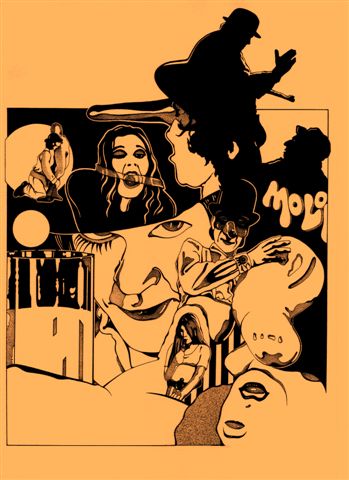
A Clockwork Reminiscence


1.
In 1981, Limeridge Mall opened in my hometown not too far from my aunt’s house. There was a Cineplex that played the big films of the day (“Porky’s”, “Raiders of the Lost Ark”, etc.) and my family took me to see Disney’s cartoon version of “Robin Hood”. I was eight years old and what I remember most about the day was the walk down the ramp to the theatres. There were separate lanes marked off with bars and on the right-hand side were the posters for each film. That was when I was struck by a huge white poster with a triangle framing the face of Alex, an eyeball and what seemed to be a naked statue of a fertility goddess.
It stayed in my mind and haunted me to see not only those images, but also the infamous tag line: “Being the adventures of a young man whose principal interests are rape, ultra-violence and Beethoven”. I understood that this was just another film about teenage violence. What got to me was Beethoven. It was ugliness meeting art; it meant to attract by its danger.
2.
Every Canada Day week-end my community is involved with a festival at Gage Park. This is a multicultural event with tents selling different types of food and goods and concerts at various stands around the park, including the huge band shell near our tent. I remember performances of bands that were huge (Honeymoon Suite) or about to become huge (kd lang). After one particular show, I helped my family and my other relatives pack up. One year in particular always stayed with me: teenagers were filling up the park at the end of once concert and I thought that there would be a riot. This wasn’t because they did anything to provoke the crowds, or because of my age (I was fourteen at the time), but I noticed what they were wearing. On almost every teenager there I saw that same image: “A Clockwork Orange” posters, ones that I had never seen before; images taken from the artists responsible for creating the original poster and other designs from the film. This was shocking and I never forgot how deep the cult of “Clockwork” could be.
No one was attacked by these teenagers; let me be clear about this. But I made an unspoken promise to myself that I would never wear one of those t-shirts. I don’t know why this was so important to me. It just seemed like a cult that I did not want to be attached to as a teenager.
3.
In the 1990s, I spent two summers working at the Hamilton Public Library. Most of my work involved sorting out the books that were to be placed on the shelves of the fiction department. This was very useful in allowing me not to work so hard. On any other floor, I would have handled guides to buying a car, science and math textbooks, dictionaries and atlases. I would have also faced questions about where to find certain books by certain authors that I had never read or cared enough to discover for myself. With fiction, it was easy to put things away and appear busy. This was how I was finally able to read “A Clockwork Orange”.
I read the book in one sitting, something that I have done very few times in my life with a novel (“The Color Purple”, the “Adrian Mole” books of Sue Townsend”, “A Bird in the House” by Margaret Laurence). I don’t know why I did this with the book. Perhaps I felt that I was doing something forbidden by reading it when I should have been working. Or maybe it was the subject matter that I already knew about from friends and my earlier experiences with the artwork and poster. I wanted to get through the book quickly without a break.
A lot of criticism about the work mentions Anthony Burgess’ innovative use of language. This created problems for the book in his home country of England (it was derided as “[a] viscous verbiage…which is the swag-bellied offspring of decay” – forgive the colourful prose; this was written in The Times Literary Supplement). Such a novel was also considered as proof that “English is being slowly killed by her practitioners”. I read these critiques long after I had read the book, but I find them important and colourful enough to quote here because of what they state about the importance of art as a disturber of convention and form. Burgess combined English slang – the title of the book was a Cockney expression he recalled from his childhood – with Russian words. And I had no trouble following or understanding the progress of Alex and his “droogs” as they “tolchoked” and “viddied real horrorshow” acts of violence. It seemed to be a future society that was very much the world as it was in that present. The teens in the book, speaking what they called “Nadsat”, needed their own language to step outside of the society that they were terrifying. It would not have made sense for them to be speaking the English of Evelyn Waugh or Graham Greene.
I was lucky to have the full ending. The Alex I read about grew up, met his future, and decided that violence was something to put away; a toy that he no longed wanted or needed to play with as an adult. I later discovered that this was not the ending that Americans were reading and for the first time I thought about how books can be perceived and reviewed (a critic, David Talbot of the New York Herald Tribune, wrote: “in a clockwork society, human redemption will have to arise out of evil”). Sometimes that “viscous verbiage” can be very beneficial soil for a character. I mentioned Greene and it strikes me that he did the same thing with his books, without the innovations of Burgess’ work (“A Clockwork Orange” was called “a philosophical novel” by Time). For the Americans, cutting the last chapter did not give them the full life of Alex; they had to add to what was missing and come to conclusions that may shock with their honesty. But I still felt uncomfortable with the work.
Anthony Burgess was a genius. Any author who can create such a character in such a particular vernacular and still have him accessible to the reader is a genius (I later discovered an edition of the book with a glossary in the back and felt sorry for the people who needed it). Alex and his narrative are as vivid, funny and terrifying as any I had read or seen anywhere else. But it was also very attractive, in a way that still bothers me. I enjoyed interpreting the language used for rape and attacks; I almost felt sorry for Alex when he was reconditioned for his re-entry into society (a society that had no use for him). This was what the author intended, I believed. There are no easy conclusions with great novels.
4.
I finally watched the film. I can remember the exact date: September 25th, 1993. The reason why the date is so clear in my mind is that it was my twentieth birthday. I was at York University studying computer science and I had decided that I would take some precious time from my schedule and watch the film. A friend in my dorm told me that at one of the libraries I could borrow a copy of the film and sit at one of the study carrels to watch it. He was also the one who showed me a copy of the book with the glossary (he did not need it, he said); he also had a different poster of the film in his room.
The film was on a course outline as a required viewing. I bluffed my way past the desk worker who wondered why a computer science major needed to see the film and went to a carrel. I will admit that a part of me did not want to see the film, but I could not face that friend who had seen the film, admired it, and wanted to discuss it with me after learning I had only read the book. I had already seen “The Shining”, “2001: A Space Odyssey”, “Dr Strangelove”, “Lolita”, “Full Metal Jacket” and “Paths of Glory” (in that order). I was not prepared for the sensation of watching “A Clockwork Orange”.
Stanley Kubrick has been called odd, aloof, distant; a hermit; a weirdo and a technology-obsessed craftsman more concerned with his cameras and lenses than his performers (Malcolm McDowell, the Alex of the film, almost drowned in the scene where the two former droogs – now police officers – take him to the forest and beat him up); an enchanter of the audience; an obsessive compulsive; and a genius. I will modify the latter title and call him a cold genius. It was easy to see why people became obsessed with this and his other films. His use of sound, slow-motion panning and colour are unlike anything seen in the films of his contemporaries. This is worthy of praise. What becomes problematic is the character of Alex. Malcolm McDowell, as was pointed out in a review of the time (1972), is the most energetic presence in the film. The adults are either perverse, wimpy, naïve, selfish, stupid or just annoying. The audience is forced to side with him (and where is McDowell’s Oscar for this performance? He deserved at least a nomination). Again, I liked the drive of the film, especially as it was told from this teenager’s point of view. But I would again face another problem with the film.
Right after this private viewing, York University had a Halloween film night in one of their auditoriums. Three films were shown – “Psycho”, “A Clockwork Orange”, “Rocky Horror Picture Show” – and I made it just in time to catch two and a half of them. I thought that the trio was odd. “Psycho” made sense as a horror film (one of the most perfect horror films ever made) – the fear in the room was palpable – and “Rocky Horror” was a nice conclusion to the evening (some of the more experienced audience members knew when to talk back to the screen, dance and break out the spray guns). “A Clockwork Orange” stood out, both in perception and audience response. If they had chosen a film like “Jaws”, I am sure that no one in the audience would be giving the shark advice on how to eat the crew of the Orca. But they did give Alex advice. As I was drawn to them, they were too; they even wanted to protect him. A key moment in the film is the accidental death of the Cat Lady. Alex bludgeons the woman with a huge phallus – an interesting touch on Kubrick’s part – and is finally shocked by something violent he has done. In the audience, from a whisper to very audible shouts, people began to yell “Fingerprints!” I would never forget this favouritism for a character. It was not the same as being impressed by the monster in “Alien” or Darth Vader’s unstoppable drive to wipe out the rebellion in the original “Star Wars” trilogy. They wanted this killer to get away. Not even his own gang wanted this to happen (recall that they smash his face with a milk bottle, leading to his arrest).
I mentioned a review of the film. I read the January 1972 review of the film by Pauline Kael (note that the film came out just after Christmas of 1971 – perfect timing?).
She was no fan of the film and appeared to be no fan of Kubrick, calling his work here the creation of a German professor obsessed with porn (whatever that really means). The most telling note in her review was the following line: “We all become clockwork oranges if we accept such films without [deciding where they are taking us]”. Kael had the opposite problem to Kubrick’s obsession with technology: her concern was with morality. Her review opened my eyes to certain things that I had not concentrated on while watching, for example: the camera that stays on the girl being raped by a gang even though they have been interrupted in the act, even following her off the stage (a “staged” rape?). There was also Alex’s punishment with the Ludovico technique. Kael saw this as manipulative (we are already on his side; why test our sympathies?). The review was biased and, perhaps, also manipulative, but it managed to air feelings that I could not name. Even Kubrick had to acknowledge the monstrous effect of the film, pulling the film out of circulation in England after gangs began mimicking the behaviour of the droogs (e.g. one person had been beaten up by a gang chanting “Singin’ in the Rain”, a key moment in the movie). Even Burgess was disturbed by the film. The studio allowed him to view the film in the autumn of 1971 with his second wife, Liana, and his agent, Deborah Rogers. Those women wanted to leave early; Burgess made them stay, but he knew that Kubrick had made literal what was only left to the imagination of the reader. In the second half of his autobiography, “You’ve Had Your Time”, he stated the following: “Its brilliance nobody could deny.” Try telling that to Miss Kael. And: “Kubrick’s achievement swallowed mine whole.”
That last quote bothers me. Burgess created a very colourful and unique narrative out of combined languages and the youth culture he had viewed in 1950s England (the first wave of Teddy Boys was a particular inspiration). It was written with an interest in creating a kind of Pilgrim’s Progress for the urban teen with too much energy and too little direction for it. In Kubrick’s film, it remained the adventure of a violent little thug who becomes part of a government campaign of redemption and manipulation (the ending was taken from the American edition of the book). This leads to the book being looked at through the lens of Kubrick’s powerful imagery and becoming a terrible work of genius that won’t go away.

Monday, August 3, 2009

Speculations (What would they have done if they had lived – music legends)

,
Brian Jones:

Co-founds WOMAD; refuses to tour with any rock group (e.g. Black Sabbath came calling); wins an Oscar and a Grammy for co-writing soundtrack to “The Last Emperor” (David Byrne is booted from the project); works as a recording engineer (many remixes of popular songs done); lives in England and France; devoted to world music, modern art and liberalizing drug laws

Jimi Hendrix:

Funk with Ohio Players at the beginning of the 70s (band works as backup musicians after he refuses to continue with Band of Gypsies); records singles with Parliament; wins case against former management company; tries reggae (booed by fans in England and America; popular in Canada and abroad); bad disco stage; awarded an honorary knighthood for work with music and the arts; living in retirement in Stratford-Upon-Avon (his home outdraws Shakespeare’s birthplace)

Mama Cass:

Talk-show host (1972 – 1976); inspired by the punk movement, writes an album of hard rock covers (bad sales); writes autobiography (painful stories of life on the road shock readers, good sales); turns down offer to re-unite with the Mamas and the Papas for extended tour; dramatic weight loss (inspired by Richard Simmons); exercise video (outsells Jane Fonda’s Workout); involved with UNICEF and Greenpeace; marries Billy Bragg; living in Bethel, NY with a large menagerie of animals

Jim Morrison:

New career as French intellectual (not taken seriously until he becomes fluent in the language); famous televised debate with Foucault and Derrida on power and control in song lyrics; returns to the US and meets Lou Reed (quick friendship and one track is written and recorded together – never released; rumoured to be called “Darkness and the Sound”); attempt on his life at a poetry reading (fan tries to stab him); now living in France (neighbour is Roman Polanski; another quick friendship established)

Janis Joplin:

Turns to Brill Building writer Carole King for her next album, “Smoke”; popular success (good sales); laryngitis (severe) stalls career; poses in Hustler (one of their most popular issues); biography on her life filmed (with her in certain key scenes) – “Joplin”; wins a Grammy and a nomination for an Oscar (Best Original Song co-nominee with Miss King); dies at the age of 65 in flood along Mississippi River (was trying to rescue people who were trapped)

Sam Cooke:

Several bestselling singles until 1970; funk recordings do not sell well (worked with Earth, Wind and Fire); experiments with reggae (singles in UK and Jamaica sell well); disco phase is brief (one bestselling single: “How Can I Cooke It?”); wins lifetime achievement award Grammy; makes first video (remake of “A Change Gonna Come” – clips from his life); suffers stroke on concert tour; retires and moves to Colorado; establishes Soul Hall of Fame Museum in Detroit (states that he wants it to rival the Rock and Roll Hall of Fame)