Thursday, August 20, 2009

Getting Served by St. Vincent


I fell. St. Vincent (AKA Annie Clark) performed at Montreal's Sala Rossa on Friday, August 7th and I was lucky enough to have a ticket for the show. The performance showcased her new album, Actor and material from her debut, Marry Me. I was also lucky enough to speak to her after the show and she was as friendly in person as she was fiery on stage (I will never forget her ripping through the Beatles' Dig a Pony - a solo showcase with electric guitar that should make P.J. Harvey and Jack White rethink their careers).
And now there is this. I found this link on Spinner, a great web site that you should check out. Miss Clark tore a new one on Lady GaGa, Lilith Fair, and the tendency of critics to lump female musicians together for the sake of convenience.
I am impressed and in love (like I said, I fell).
Enjoy!

Tuesday, August 18, 2009

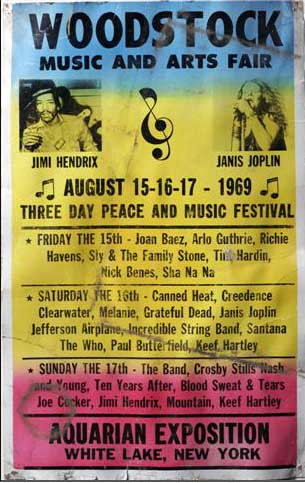
Back to the Mud: Woodstock at 40


Forty years ago this past week-end, a festival took place which was a perfect example of how not to run a festival. Tickets, around 160,000 of them, were sold, but there were no booths on site to collect them. The promoters had to convince the local state government to not send in soldiers to disperse the unexpected number of young people who appeared. Those same promoters would lose money and temporarily shut down the show beforehand. There were worries about expenses, sanitation and the possibility of mass electrocutions due to exposed cables in the gouged and muddy ground.

Ahh...Woodstock.

To invoke its name is to draw one to a particular time in the summer of 1969 when three days of music change the world. An older generation still looks on it with disbelief; a younger generation is often unable to imagine it ever took place. Too many of the big musical events of our present age - Live Aid I & II, Bonnaroo, Osheaga, etc. - have been tied into definite causes, or promoted and used as blatant commercial vehicules. This is not to say that none of the bands on Max Yasgur's farm were unaware of the exposure the show would provide, or that they were in it just for their fans. But there was clearly something untainted and optimistic about that time.

This is why I have a hard time believing it ever happened. Yes, I have seen the film. Yes, I have read books and seen photos. Boomers are often eager to talk about events from that decade. I am not doubting the mass gathering of people or the fiery performances of many of the bands. It just strikes me as odd that any number of human beings could get together like that without riots, violence and the threat of disease and jail time (perhaps Woodstock 1994 coloured my perceptions).

I mentioned commercialism. There was no product placement on stage or on the crowded roads heading to the farm. Many big names had decided to stay away - the Doors; Zappa and his Mothers of Invention; Dylan, who was living nearby; the Beatles, who had their own problems; and the Rolling Stones, who would lead the Age of Aquarius to a particular nadir at Altamont - but the ones that went on with the show will never be forgotten. The Who ripped through their classic singles and their just released rock opera Tommy; Alvin Lee with Ten Years After became a guitar god; Crosby, Stills, Nash and Young played their second show as a quartet that weekend; and Jimi Hendrix gave us a proper, up-to-date version of The Star-Spangled Banner.

I recently watched Santana's performance of Soul Sacrifice while flipping between stations during the film's airing on a art TV channel. And I finally got it: the day and the spirit could never be repeated again. I flipped past the Pussycat Dolls and Black-Eyed Peas doing their thing on video and noticed how they were both stomped and utterly forgettable next to the energy and spirit of Santana and company.

You may say that the festival may have spoiled musicians and record labels with the idea that the audience for music was much bigger than expected. They learned how to play a new game. But that one rare moment in the rain and mud deserves to be envied and looked on with awe.

Back to the garden, folks...

"I wish I had gone to Woodstock. That was a story." - Walter Cronkite

Sunday, August 16, 2009

Elvis Presley: Uncomfortable Icon


Thirty-two years ago this week, a singer died at his palatial home after spending most of his life as a performer who never understood the greed and ignorance of the industry which used him and barely comprehended his talent.
That is the melodramatic way to read the fall of Elvis Presley. In other quarters, it would sound like this: a dumb kid with a glorious voice and a wonderful ability to interpret any song he chose to sing became fat, drug-addicted and died in his bathroom from a combination of bad dietary and pharmaceutical habits which enlarged and damaged his already too-broken heart.
Yes, it is cold to read it that way on the page. But both interpretations contain their own truth. For those people who will spend this August 16th waiting in line to get into Graceland – memorabilia collectors, impersonators, desperate housewives and the just plain curious – the latter paragraph is blasphemy. They need their Elvis, no matter how distant and messed up the life they honour. They need their memories massaged and whatever love they can find restored.
And what is not to love? Elvis was a true performer; a man who loved to be out in front of the audience doing what he came to see as the most natural and untainted act of his overexposed life: singing. And he was born to sing. Listening to Elvis: 30 #1 Hits, it is hard not to have your ears seduced by this release of his chart-topping hits, even if you are like many critics of a particular generation and have never bothered to pick up a Presley recording in your entire life. Yes, he only (co-)wrote two songs (and was much more interested in gospel – his first love – as a musical idiom) but what he chose to cover became classics: Heartbreak Hotel, Don’t Be Cruel, Are You Lonesome Tonight?, All Shook Up, Love Me Tender, Suspicious Minds… The list feels endless and cannot be completely comprehensive.
As well, like any performer worth watching, Elvis knew his audience. His moves may not have been choreographed, but they came from a history of culture clashing as American as it was raw and unsettling. And this is where Elvis becomes a problematic figure. He reinterpreted and remade the moves, attitudes and behaviour of singers and music from different genres into something palatable for both white teenagers and the blue-rinse set.
Not that this was a plan. Again, it must be reiterated that Presley’s approach to music and performance did not come out of a meeting of business executives. His very presence as a performer in 1950s America altered the culture in such a way that the aftershocks still echo throughout the nation and beyond. When he was seen as a danger to the morals of youth, he was a gift. After his stint in the army, he returned to music, including more lamentable films and overlong touring schedules to his life. This turned him into another celebrity casualty. He became an uncomfortable image of all that America can do to those who do not conform while creating their art. He was tamed for all to enjoy.
The last thing that can be said about Elvis is the first thing that should be thought about him: it is impossible to imagine music from the last fifty years – roughly the moment when he joined RCA and became a commercial recording star – without his shimmering presence. Keep this in mind when you think about what it cost him. It is the true tragedy of the Presley story: he was never allowed to escape his own legend.

Thursday, August 13, 2009

Clare Torry and the Great Gig in the Sky


Clare Torry was one of the most important British vocalists of the early 70s. And you are forgiven for not knowing her name. This is fair. She was a session singer who never gained the fame of some of her contemporaries. But she was always there, adding her distinctive sound to various recordings. She would also become immortalized through a late-night session that no one predicted would last in the musical memories of so many fans.

Miss Torry sang with Olivia-Newton John, Alan Parsons Project and Meat Loaf in her work as a back-up vocalist. None of her own recordings became great hits, although there are compilations of her work that are worth listening to. It was a wet Sunday evening in 1972 that gave her a place in musical history. She was called into Abbey Road studios to add her voice to an instrumental track that a band had trouble completing. At first, it seemed as though the session would go nowhere. The band offered nothing but rejections when she gave standard interpretations with lyrics along the lines of “Baby, oh how I love you,” etc. It would take several sessions before Miss Torry hit upon the idea of turning her vocal performance into a completely emotional performance divorced from any discernable lyrics. Finally, the band felt satisfied with what it heard and sent her on her way. She went out to dinner with her boyfriend that night without any knowledge of how moving and important her contribution was until she saw the album on sale at a local record shop. Still, she had made her 30 pounds for the work.

That session had produced the immortal The Great Gig in the Sky, arguably the most moving track on Pink Floyd's The Dark Side of the Moon. Her wailing, cooing performance has been described as someone in an “orgasmic or terrified” emotional state. There is very little reason to make any sort of distinction between the two when considering the album’s themes of loneliness, longing, despair and paranoia. Miss Torry managed to encapsulate all of this with her vocal. And it was all her idea. Rick Wright's piano feels like it was added as an afterthought.

Oh, that 30 pounds would not do. Clare Torry would sue the band for copyright and a share of royalties on the song. From 2005 onwards, “The Great Gig in the Sky” would be credited as a Rick Wright/Clare Torry creation.

She must have the final word: “If it had been the Kinks, I would have been over the moon.”

Wednesday, August 12, 2009

Goodbye Mr Hughes


John Hughes, the cinematic Dickens of eighties suburban teenage life, died last week of a heart attack while walking through Manhattan early one morning. He was only 59 years old. That, of course, makes me feel old. I grew up with his work, as so many others have, and it feels like a large portion of my visual memory has been brought back to bear on movies that came far too close to the truth. And as uncomfortable as I feel doing so, I have to look back.
It starts with a poll. The Globe and Mail, Canada's national newspaper, ran a poll on the most popular John Hughes film. I chose The Breakfast Club; most of the World Wide Web chose Ferris Bueller's Day Off. How naive of me. I thought that the tale of a group of detentioneers discovering themselves and each others' foibles would be on top (it only received 16% of the vote). Ferris is the tale of a smart-ass kid who is always on top of things, always breaking the rules, and always getting away with it. It was almost too cartoonish a choice. But I understand why it came out on top (36% chose it).
1986 and I am twelve years old, waiting in line at the Odeon theatre to see the film in its first week (I still have a poster and button with the film's logo and Save Ferris written on it). I sit and watch. And then I just gape. I had never seen a film with a direct address to the audience. I had never seen a film with a direct address to a teenage audience (one which I was near enough to qualify for). I just could not believe that they got away with it. The only problem was I saw the film with my mom (hey, I was only twelve and had to go downtown to see it). It was the wrong choice of companion for a day at the movies.
I am serious about that. John Hughes understood a particular type of moment in life: the state of youthdom when things are becoming defined and hardened around you, and there is little you can do to change it. It would be hard to imagine him making a film about post-secondary life that followed these same type of characters. The director who made Sixteen Candles and Pretty in Pink does not seem to be the same one who made Uncle Buck or Planes, Trains and Automobiles. He found a space and occupied it well. I still feel like I was Anthony Michael Hall looking for that eternal Molly Ringwald who wanted nothing to do with me (like I said, he really understood adolescence, especially my own teenage life).
In the same paper, Globe and Mail writer Lynn Crosbie commented on how she felt a distance from the people on the film because of their age. I do admit that I sometimes felt the same way. There is something cynical and sweet, distant and perceptive in how Hughes draws you into his films while teasing his audience with the idea that the characters are who you are (esp. if you were white, middle-class and living in an area that looked remarkably like Chicago in every film).
But that is a critique that will fade and disappear as his films are reassessed, re-examined and remembered. We needed to have this type of filmmaker in 1980s America and I cannot imagine my moviegoing life without those stories.
Mr Hughes, I thank you.

Monday, August 10, 2009

Second Thoughts on a Second Skin


This will be a little chat about condoms, so I will try to bring a mature and sensitive voice to the following:

Sausage Wrappers have been around for just over two centuries, not quite as long as men and women have wanted to have them around, but long enough for a certain generation to avoid the responsibility imposed by unwanted pregnancies, proactive diseases and soon-to-be-less-than-attractive overnight partners. Sheep placentas were the first Meat Cocoons available; soon, modern technology began its long and intrusive interest in sex and reproduction. The new age of Rubber Rod Retainers began in earnest at the beginning of the twentieth century. This coincided with the appearance of the automobile, bobbed hair, short(er) skirts, the Jazz Age, bathtub gin, and a general sense of freedom that comes after surviving a world war and lethal pandemic; may as well have some fun while you can.

The Age of Aquarius – okay, that era from 1964 to 1973 – disowned most of the responsibility created by their parents and avoided Plastic Penis Packers for an ethos of free love, long hair, drug use and uncensored promiscuity. It was called The Sexual Revolution, a battle which left the bacilli victorious. By the eighties, disease became the main concern of any sexual partner who wanted to protect themselves and others with a Shrink-To-Fit Coat. The times changed and protection remained the same.

Or did it? From the names of these Synthetic Semen Stoppers, you could conclude that they are very pertinent and relevant to an age of determined and demanding consumers. First, there is Trojan. Yes, it is dated, but this is a rather wise choice of a name. It makes you think of not only a horse but also hidden danger. Then there is Lifestyles. Rather bland, but the specific brand names do speak of the possibilities available to lucky users. “Peace and Love,” “Natural Feeling” and – no pressure here – “Endurance” all speak for themselves. One of the oldest names in the business, Durex, still sounds like a planet Captain Kirk and his crew could have visited while boldly going where no one had gone before.

Then there are the Naughty Raincoats of other countries. The Japanese believe that men with large noses are also well-endowed below the waist. There is one company that goes so far as to put a large nose on specific boxes meant for the well-overhung. These particular Snake Jackets come with names like Jellia Coat and Honey, and they should not be used by wishful thinkers.

There is still the difficulty faced in buying some of these Boner Baggies with a straight face. The local drugstore seems far too hygienic and clean for a purchase. You should head out to the specialty shops, restrooms with the right vending machines, university/college campuses, and particular conferences and seminars (Montreal, Quebec's Salon de l’Amour et Seduction is always a good bet). The goods may be in our public eye, but not quite yet in our discourse. However, it seems that most sexually active people know what they want and how to get it. It may even be possible for men to buy a Baby Blocker without embarrassment.

But do they know not to call it a “rubber?”

Sunday, August 9, 2009

YouTube Etiquette


To understand the web, the only thing to do is to dive in and hope that you make it back to the surface. There are perils and joys to discover. The Internet is unique in that it can both reward and rob you at the same time. The world is at your nearest mouse click, but it eats up all of your time trying to find the next new thing. For any form of technology offering several billion pages of information, this is inevitable.
Of course, one of the most popular web pages out there is YouTube, a site that allows one to see amateur musicians, bad dancers, and almost-forgotten television programs which can now be enjoyed before they are pulled by the networks over copyright infringement laws. It has redefined what we can use the web for because it allows to the viewer to be a participant instead of the normally passive figure in front of a screen. And it is no surprise that television has lost viewers to the Internet. Why be a spectator when you can both play the game and coach yourself?
As with any new toy, there are those who are willing to abuse it. There are a lot of web pages and links that can offend, bore and just make you think that the best instincts of the World Wide Web community are perverse, predictable and just plain ugly. YouTube is just as guilty as any other page when it comes to this link of abuses. Think of the endless number of negative comments that are posted over a simple message; or the uploaders who have decided to get their messages heard by promising porn. Antagonism is rife and will not end without some sort of general understanding of how the site should be used.
With this point of reference, it is necessary to propose some rules of usage, a list of etiquette that should be applied to this page. It is not a list to start some sort of censorship, or self-censorship. A viewer already has the option to flag videos that they do not like or think are offensive. It is simply listed to show just how absurd things have become on the page that encourages you to Broadcast Yourself.
Let’s start with the names. Number one rule: Choose a decent handle for yourself, not something that reminds browsers of the already low standards of grammar on the web. jazzoholic works (it is witty, clever and speaks of two obsessions that often go hand in hand); whizzypoo does not (the reasons for this are obvious, in a scatological sense), and both are very real and very used names in the Comments section of the page.
Next: the comment itself. Please don’t quote lines from the clip that you and the rest of the surfers on the Web have just watched. Apart from the hearing-impaired viewers out there, people know what they have just seen. Leave comments that comment, not ones that repeat.
No more ads for porn web sites that do not offer anything for free; also, no more multiple ads for the same porn web site with one comment (doesn’t anyone understand the concept of diversifying?). Add to this the desire to straight-out porn on the regular YouTube site (and no more nonsense like using a sexy still shot for an upload of your drunken idiot friends pretending to act). If the web site's founders really want to compete, they should be giving YouPorn and xHamster a hard time (so to speak…)
Now, if you have made it to the web page and have become a subscriber, please learn a little about punctuation and spelling before leaving a comment. It simply looks better on the page if you get these things right instead of telling the world how much “yu lurv de chic wif the beeg nawbs”.
And this is a personal one: more information on the great Mentos/Diet Coke experiments. If you have not seen this in action, you should get onto the site right now and experience the joy of propulsion and carbonation in tandem with “the freshmaker”.
And then there is this: not in itself a bad thing, but please keep the lesbian kissing to a minimum. And tell the truth: most of those girls are not really lesbians and are providing the wrong sort of information to all of the lonely and horny teenage boys out there. Truth in advertising is a precious thing.
Now, about the comments on the comments: if someone receives more than five thumbs-down clicks, that is just wrong. They usually remain hidden, but it seems like overkill or abuse to see -15 next to the downward-turned digit just because someone doesn’t like a video. And don’t bother adding more and more negative written comments against one idiot you don’t like. This is distracting and perhaps a way of falling into a carefully-laid trap (there is no such thing as bad press).
Finally, the pulled videos: why do the networks do this? They hate the free advertising? The interest in their product is drawing people away the boob tube? No, it is all a question of money and advertising. So, here is what you can do: screw with them! Keep posting their clips, no matter how often they pull them down. Their writers were just on strike; maybe their viewers should join them.
YouTube is here and we have gotten used to it. We should know how to use it.