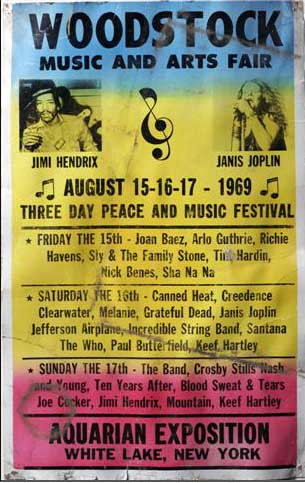
Forty years ago this past week-end, a festival took place which was a perfect example of how not to run a festival. Tickets, around 160,000 of them, were sold, but there were no booths on site to collect them. The promoters had to convince the local state government to not send in soldiers to disperse the unexpected number of young people who appeared. Those same promoters would lose money and temporarily shut down the show beforehand. There were worries about expenses, sanitation and the possibility of mass electrocutions due to exposed cables in the gouged and muddy ground.
Ahh...Woodstock.
To invoke its name is to draw one to a particular time in the summer of 1969 when three days of music change the world. An older generation still looks on it with disbelief; a younger generation is often unable to imagine it ever took place. Too many of the big musical events of our present age - Live Aid I & II, Bonnaroo, Osheaga, etc. - have been tied into definite causes, or promoted and used as blatant commercial vehicules. This is not to say that none of the bands on Max Yasgur's farm were unaware of the exposure the show would provide, or that they were in it just for their fans. But there was clearly something untainted and optimistic about that time.
This is why I have a hard time believing it ever happened. Yes, I have seen the film. Yes, I have read books and seen photos. Boomers are often eager to talk about events from that decade. I am not doubting the mass gathering of people or the fiery performances of many of the bands. It just strikes me as odd that any number of human beings could get together like that without riots, violence and the threat of disease and jail time (perhaps Woodstock 1994 coloured my perceptions).
I mentioned commercialism. There was no product placement on stage or on the crowded roads heading to the farm. Many big names had decided to stay away - the Doors; Zappa and his Mothers of Invention; Dylan, who was living nearby; the Beatles, who had their own problems; and the Rolling Stones, who would lead the Age of Aquarius to a particular nadir at Altamont - but the ones that went on with the show will never be forgotten. The Who ripped through their classic singles and their just released rock opera Tommy; Alvin Lee with Ten Years After became a guitar god; Crosby, Stills, Nash and Young played their second show as a quartet that weekend; and Jimi Hendrix gave us a proper, up-to-date version of The Star-Spangled Banner.
I recently watched Santana's performance of Soul Sacrifice while flipping between stations during the film's airing on a art TV channel. And I finally got it: the day and the spirit could never be repeated again. I flipped past the Pussycat Dolls and Black-Eyed Peas doing their thing on video and noticed how they were both stomped and utterly forgettable next to the energy and spirit of Santana and company.
You may say that the festival may have spoiled musicians and record labels with the idea that the audience for music was much bigger than expected. They learned how to play a new game. But that one rare moment in the rain and mud deserves to be envied and looked on with awe.
Back to the garden, folks...
"I wish I had gone to Woodstock. That was a story." - Walter Cronkite


