Showing posts with label Beethoven. Show all posts

Wednesday, August 5, 2009

Ten Reasons Why Literature Is Better than Music


1. Formats
It is very easy to sit back and open up an old paperback or a hardcover book and enjoy it. It is not so easy to do the same with old technology. It demands constant updating. To wear an old orange-foam headset plugged into an original tape-only Sony Walkman and expect to be treated fairly in a world of iPods and various other shrunken portable devices is a sad dream. The humiliation of not being up to date with your technology is immediate and palpable.

2. Engagement
This may be a little tricky to explain without an example:
We have all heard of child prodigies. According to the official story, Mozart was such a prodigy. He was also very annoying company and tolerated only as long as his music was fashionable (in his lifetime, this was very brief). He had sponsors at court and only had to worry about money near the end of his life. And his music still lives.
Now, how many writing prodigies have you heard of (children who can produce a brilliant novel before they have succumbed to puberty)? There are none that I can name – none on any school syllabus that I can remember – and I think I know why: literature requires the experience of living in the world and commenting on the society one is in. The best writers always do this no matter where they find themselves. Musicians are not obligated to do this. They create melodies that linger in the head and can be easily recalled or interchanged with another song. Writers have the more difficult task of engagement and understanding what they have been given.

3. Reverence
I will admit that I enjoy looking at old vinyl album covers. They are just the right size to be considered a kind of framed art work (a painting to accompany the sounds you just purchased). But the vinyl format is now just for collectors, hipsters and DJs. We now want CDs – sometimes – and downloads.
Now, head over to an antiquarian specializing in old books. Try not to feel any sense of awe in handling or even gazing up at a book from several decades or a century ago. I was once employed to handle rare books kept in storage at the central branch of my hometown’s library. I still feel honoured to have been entrusted to catalogue records of the city’s history and tracts from early pioneers and founders of the town. I never felt that way skimming through my uncle’s selection of dance music from the 1960s.

4. Books on Tape (or CD)
The title of this section just proves my point. Why did companies feel the need to move one format onto another format? It began with records; for convenience, it moved onto audio tapes. There are now books recited on CDs.
Music companies do not feel the need to do this. Musicians read scores; fans of certain musical icons can read about their favourite stars in magazines and books. There is not much demand to read a phonetic transcription of the symphonic work of Beethoven. The interest only works in one direction. Books on tape or CD prove that even if someone does not want to open a book, they still want a story.

5. Imagination
This one is also debatable. Music does open up certain sensations and certain feelings in the mind and/or soul. But not much effort is needed to feel moved by a melody. For some, Beethoven’s 9th symphony is a moving experience that transcends all others. For another clique, the creative output of the latest pop star grinding through another pop hit is their reason for listening to music.
A book demands certain things that make it inconvenient: you have to invest time in it; you have to follow and understand the plot, characters, setting, themes, etc.; and you have to come to your own conclusions after you are done. It stimulates the imagination to do more than just remain a passive witness to the art. Music makes none of these demands, and – like television or a movie – you can step away from it and not truly think about the experience. This is much harder to do after reading Tolstoy’s masterpieces or a Shakespeare tragedy.

6. Physical Damage
I will return to Beethoven: He went deaf. This is one of the worst cosmic jokes in the history of music. And there is the other problem of how we listen to music today. There have been many warnings about how loud we listen to music in night clubs and on portable devices. A report a year ago noted the damage caused to the hearing of teenagers just from the mp3 format itself. This does make me wonder if I should get into a sound competition with the noises around me when I try to write with a headset on in a café.
There is not much call to get people to stop reading to save their eyesight. And yes, for those of you who know about the lives of writers, John Milton and James Joyce were two casualties to poor vision (Milton recited part of Paradise Lost while blind; Joyce was reduced to writing one large word per page to complete his last book). But note that both men could still experience their work while losing a key sense related to that work. Beethoven’s suffering was far more extreme. And he never owned an iPod.

7. Tangibility
This is exaggerating, perhaps, but it is a different experience to hold a book in one’s hands than it is to hold a CD. There is the sense of something precious about a book read and cherished. You want to hold on to it (the edition, the shape, the cover – they remain unique and unchangeable); you want to keep what you know. I never felt that way when I downloaded music to my drive, or transferred CDs to my memory cards.
We like to hold onto books; music is slipping away from our grasp every year.

8. Perception
Step onto a bus, train or subway and look for the people listening to music. Now, when you have spotted them, and they have not yet asked you to leave them alone, try and guess what they are listening to; you may actually hear what they have on (see section on “Physical Damage”). Depending on the subject’s age, sex, colour and grooming habits, you may be able to neatly categorize them under different types of popular music (w. perhaps a few allowances for jazz and classical music).
Take that same locale and check out the readers: that man in a business suit reading Dickens; the woman beside in a nurse’s outfit with a classic of Victorian literature; the young woman with the heavy novel written by someone you have never heard of. What have you learned about them? With music, immediate prejudices come out; books – depending on their covers (yes, they sometimes matter) – will require a little bit of thought. This may help you get through the commute, despite the irritation of the noise from the mp3 of the man next to you who is obviously infatuated with electronic dance music.

9. Books Made into Films
Much like my comments about books on tape, many books make an easy transfer to a visual medium: Jaws, The Godfather, The Reader, A Clockwork Orange, and Donnie Brasco. These books were received with different levels of praise and are still admired and dismissed today. But they are also unforgettable because of the films they inspired and many readers now cite them as the reason why they have any sort of information about the books. This can be accepted. Reading, for example, A Clockwork Orange and then watching it on film provide two very different rewards, one visual and aural, the other linguistic and dramatic. The interchange of mediums is a success.
Music on film? Only experimental films seem to work well with music (cf. Thirty-Two Short Films about Glenn Gould). Music is in the background in films; and although they may add to the vision of a director, they cannot replace it (this may be the reason why most soundtracks for most films are forgettable creations). When a director makes a supreme effort to get the musical process on film, you end up with the work of Ken Russell, an unpleasant result for audience and music lover alike (cf. The Music Lovers). As proven by this and other musical biographies, there is no need to see the life if we have the music. There is even less need to recreate – or at least attempt to recreate – the means by which the music was created. Not everyone is familiar with the strange life of Jean Sibelius, but his music can still move them. The visual medium of film cannot add to another medium that exists to disappear and remain a lingering element in the mind. The clash is inevitable.

10. Personal Prejudice
Just accept it: we all have our biases and beliefs about each other, whether they are cultural, sexual, and racial and so on. What about our musical hang-ups? Head back to that bus, metro or train and find the groups of people who belong to their own particular clique. A part of that clique will be formed via the sounds they enjoy. A Goth pair listening to the latest from Marilyn Manson or Tool may not be so interested in making friends with the pair of girls gossiping about their favourite Jonas Brother. Music does segregate, moving into listening devices, clothing, and opinions about that other group.
Now, this does not happen with bookworms. I have never seen a Stephen King fan shunned by a book-loving group devoted to Peter Straub. Harry Potter fans can understand and perhaps even enjoy the work of J.R.R. Tolkien. And Thomas Harris fans have a lot to discuss with devotees of Dashiell Hammett and Raymond Chandler (although the latter may not appreciate all the gore).
Yes, I am not playing fair with this last argument. I have not placed Stephen King next to Tolstoy, or Mr Harris on a list with the work of Walter Benjamin. There are readers for many of the former in those pairs who may never touch the latter, and vice versa. But I have never felt excluded from the low and high in my choice of books. We all start with comic strips and books; we have the standard classics of children’s literature; and we may enjoy pulp and romance books. But all of this varied reading forms a whole that allows a lover of books to think openly and wisely. Biases may form, but they can be overcome by acknowledging our original sources of enchantment.

Tuesday, August 4, 2009

A Clockwork Reminiscence


1.
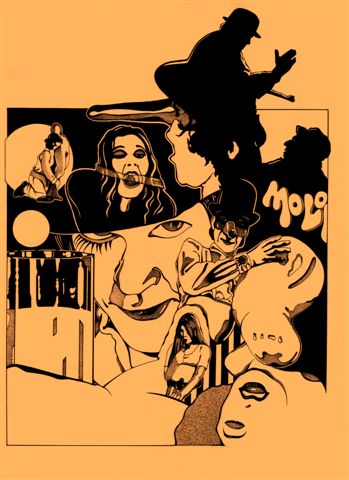
In 1981, Limeridge Mall opened in my hometown not too far from my aunt’s house. There was a Cineplex that played the big films of the day (“Porky’s”, “Raiders of the Lost Ark”, etc.) and my family took me to see Disney’s cartoon version of “Robin Hood”. I was eight years old and what I remember most about the day was the walk down the ramp to the theatres. There were separate lanes marked off with bars and on the right-hand side were the posters for each film. That was when I was struck by a huge white poster with a triangle framing the face of Alex, an eyeball and what seemed to be a naked statue of a fertility goddess.
It stayed in my mind and haunted me to see not only those images, but also the infamous tag line: “Being the adventures of a young man whose principal interests are rape, ultra-violence and Beethoven”. I understood that this was just another film about teenage violence. What got to me was Beethoven. It was ugliness meeting art; it meant to attract by its danger.
2.
Every Canada Day week-end my community is involved with a festival at Gage Park. This is a multicultural event with tents selling different types of food and goods and concerts at various stands around the park, including the huge band shell near our tent. I remember performances of bands that were huge (Honeymoon Suite) or about to become huge (kd lang). After one particular show, I helped my family and my other relatives pack up. One year in particular always stayed with me: teenagers were filling up the park at the end of once concert and I thought that there would be a riot. This wasn’t because they did anything to provoke the crowds, or because of my age (I was fourteen at the time), but I noticed what they were wearing. On almost every teenager there I saw that same image: “A Clockwork Orange” posters, ones that I had never seen before; images taken from the artists responsible for creating the original poster and other designs from the film. This was shocking and I never forgot how deep the cult of “Clockwork” could be.
No one was attacked by these teenagers; let me be clear about this. But I made an unspoken promise to myself that I would never wear one of those t-shirts. I don’t know why this was so important to me. It just seemed like a cult that I did not want to be attached to as a teenager.
3.
In the 1990s, I spent two summers working at the Hamilton Public Library. Most of my work involved sorting out the books that were to be placed on the shelves of the fiction department. This was very useful in allowing me not to work so hard. On any other floor, I would have handled guides to buying a car, science and math textbooks, dictionaries and atlases. I would have also faced questions about where to find certain books by certain authors that I had never read or cared enough to discover for myself. With fiction, it was easy to put things away and appear busy. This was how I was finally able to read “A Clockwork Orange”.
I read the book in one sitting, something that I have done very few times in my life with a novel (“The Color Purple”, the “Adrian Mole” books of Sue Townsend”, “A Bird in the House” by Margaret Laurence). I don’t know why I did this with the book. Perhaps I felt that I was doing something forbidden by reading it when I should have been working. Or maybe it was the subject matter that I already knew about from friends and my earlier experiences with the artwork and poster. I wanted to get through the book quickly without a break.
A lot of criticism about the work mentions Anthony Burgess’ innovative use of language. This created problems for the book in his home country of England (it was derided as “[a] viscous verbiage…which is the swag-bellied offspring of decay” – forgive the colourful prose; this was written in The Times Literary Supplement). Such a novel was also considered as proof that “English is being slowly killed by her practitioners”. I read these critiques long after I had read the book, but I find them important and colourful enough to quote here because of what they state about the importance of art as a disturber of convention and form. Burgess combined English slang – the title of the book was a Cockney expression he recalled from his childhood – with Russian words. And I had no trouble following or understanding the progress of Alex and his “droogs” as they “tolchoked” and “viddied real horrorshow” acts of violence. It seemed to be a future society that was very much the world as it was in that present. The teens in the book, speaking what they called “Nadsat”, needed their own language to step outside of the society that they were terrifying. It would not have made sense for them to be speaking the English of Evelyn Waugh or Graham Greene.
I was lucky to have the full ending. The Alex I read about grew up, met his future, and decided that violence was something to put away; a toy that he no longed wanted or needed to play with as an adult. I later discovered that this was not the ending that Americans were reading and for the first time I thought about how books can be perceived and reviewed (a critic, David Talbot of the New York Herald Tribune, wrote: “in a clockwork society, human redemption will have to arise out of evil”). Sometimes that “viscous verbiage” can be very beneficial soil for a character. I mentioned Greene and it strikes me that he did the same thing with his books, without the innovations of Burgess’ work (“A Clockwork Orange” was called “a philosophical novel” by Time). For the Americans, cutting the last chapter did not give them the full life of Alex; they had to add to what was missing and come to conclusions that may shock with their honesty. But I still felt uncomfortable with the work.
Anthony Burgess was a genius. Any author who can create such a character in such a particular vernacular and still have him accessible to the reader is a genius (I later discovered an edition of the book with a glossary in the back and felt sorry for the people who needed it). Alex and his narrative are as vivid, funny and terrifying as any I had read or seen anywhere else. But it was also very attractive, in a way that still bothers me. I enjoyed interpreting the language used for rape and attacks; I almost felt sorry for Alex when he was reconditioned for his re-entry into society (a society that had no use for him). This was what the author intended, I believed. There are no easy conclusions with great novels.
4.
I finally watched the film. I can remember the exact date: September 25th, 1993. The reason why the date is so clear in my mind is that it was my twentieth birthday. I was at York University studying computer science and I had decided that I would take some precious time from my schedule and watch the film. A friend in my dorm told me that at one of the libraries I could borrow a copy of the film and sit at one of the study carrels to watch it. He was also the one who showed me a copy of the book with the glossary (he did not need it, he said); he also had a different poster of the film in his room.
The film was on a course outline as a required viewing. I bluffed my way past the desk worker who wondered why a computer science major needed to see the film and went to a carrel. I will admit that a part of me did not want to see the film, but I could not face that friend who had seen the film, admired it, and wanted to discuss it with me after learning I had only read the book. I had already seen “The Shining”, “2001: A Space Odyssey”, “Dr Strangelove”, “Lolita”, “Full Metal Jacket” and “Paths of Glory” (in that order). I was not prepared for the sensation of watching “A Clockwork Orange”.
Stanley Kubrick has been called odd, aloof, distant; a hermit; a weirdo and a technology-obsessed craftsman more concerned with his cameras and lenses than his performers (Malcolm McDowell, the Alex of the film, almost drowned in the scene where the two former droogs – now police officers – take him to the forest and beat him up); an enchanter of the audience; an obsessive compulsive; and a genius. I will modify the latter title and call him a cold genius. It was easy to see why people became obsessed with this and his other films. His use of sound, slow-motion panning and colour are unlike anything seen in the films of his contemporaries. This is worthy of praise. What becomes problematic is the character of Alex. Malcolm McDowell, as was pointed out in a review of the time (1972), is the most energetic presence in the film. The adults are either perverse, wimpy, naïve, selfish, stupid or just annoying. The audience is forced to side with him (and where is McDowell’s Oscar for this performance? He deserved at least a nomination). Again, I liked the drive of the film, especially as it was told from this teenager’s point of view. But I would again face another problem with the film.
Right after this private viewing, York University had a Halloween film night in one of their auditoriums. Three films were shown – “Psycho”, “A Clockwork Orange”, “Rocky Horror Picture Show” – and I made it just in time to catch two and a half of them. I thought that the trio was odd. “Psycho” made sense as a horror film (one of the most perfect horror films ever made) – the fear in the room was palpable – and “Rocky Horror” was a nice conclusion to the evening (some of the more experienced audience members knew when to talk back to the screen, dance and break out the spray guns). “A Clockwork Orange” stood out, both in perception and audience response. If they had chosen a film like “Jaws”, I am sure that no one in the audience would be giving the shark advice on how to eat the crew of the Orca. But they did give Alex advice. As I was drawn to them, they were too; they even wanted to protect him. A key moment in the film is the accidental death of the Cat Lady. Alex bludgeons the woman with a huge phallus – an interesting touch on Kubrick’s part – and is finally shocked by something violent he has done. In the audience, from a whisper to very audible shouts, people began to yell “Fingerprints!” I would never forget this favouritism for a character. It was not the same as being impressed by the monster in “Alien” or Darth Vader’s unstoppable drive to wipe out the rebellion in the original “Star Wars” trilogy. They wanted this killer to get away. Not even his own gang wanted this to happen (recall that they smash his face with a milk bottle, leading to his arrest).
I mentioned a review of the film. I read the January 1972 review of the film by Pauline Kael (note that the film came out just after Christmas of 1971 – perfect timing?).
She was no fan of the film and appeared to be no fan of Kubrick, calling his work here the creation of a German professor obsessed with porn (whatever that really means). The most telling note in her review was the following line: “We all become clockwork oranges if we accept such films without [deciding where they are taking us]”. Kael had the opposite problem to Kubrick’s obsession with technology: her concern was with morality. Her review opened my eyes to certain things that I had not concentrated on while watching, for example: the camera that stays on the girl being raped by a gang even though they have been interrupted in the act, even following her off the stage (a “staged” rape?). There was also Alex’s punishment with the Ludovico technique. Kael saw this as manipulative (we are already on his side; why test our sympathies?). The review was biased and, perhaps, also manipulative, but it managed to air feelings that I could not name. Even Kubrick had to acknowledge the monstrous effect of the film, pulling the film out of circulation in England after gangs began mimicking the behaviour of the droogs (e.g. one person had been beaten up by a gang chanting “Singin’ in the Rain”, a key moment in the movie). Even Burgess was disturbed by the film. The studio allowed him to view the film in the autumn of 1971 with his second wife, Liana, and his agent, Deborah Rogers. Those women wanted to leave early; Burgess made them stay, but he knew that Kubrick had made literal what was only left to the imagination of the reader. In the second half of his autobiography, “You’ve Had Your Time”, he stated the following: “Its brilliance nobody could deny.” Try telling that to Miss Kael. And: “Kubrick’s achievement swallowed mine whole.”
That last quote bothers me. Burgess created a very colourful and unique narrative out of combined languages and the youth culture he had viewed in 1950s England (the first wave of Teddy Boys was a particular inspiration). It was written with an interest in creating a kind of Pilgrim’s Progress for the urban teen with too much energy and too little direction for it. In Kubrick’s film, it remained the adventure of a violent little thug who becomes part of a government campaign of redemption and manipulation (the ending was taken from the American edition of the book). This leads to the book being looked at through the lens of Kubrick’s powerful imagery and becoming a terrible work of genius that won’t go away.