Monday, September 28, 2009

The Fan (a poem)


This is a poem that I wrote some time ago and it seems appropriate for this time of year (baseball season is winding down; hockey season is gearing up). It is in the villanelle form - like Dylan Thomas' Do Not Go Gentle Into That Good Night - and it has its own narrative and logic. And it is funny, too!

“Just let me finish with the game, honey.”
My wife just sat there, staring into space.
“Last time I checked, the score was 3 to 3,

And could you pass me my beer if you see
it by the lamp…with the bulb I will replace…
Just let me finish with the game, honey.

“That last goal was disallowed, but tell me
why he’s still on?” (She had started to pace.)
“Last time I checked the score was 3 to 3.

And I didn’t see the damn referee
until they passed to…what’s-his-face…
Just let me finish with the game, honey.”

I guess she must have heard. I knew that she
had to go out tonight (no time to waste)…
“Last time I checked, the score was…3 to 3.”

(Very stupid words to repeat, believe
me.) She left with her purse (and suitcase?)
“Just let me finish with the game…honey?
Last time I checked, the score was 3 to 3.”

Friday, September 25, 2009

Observations on my Birthday


Yes, I got older today, and not because of the job-hunting or stress. I will not give my age here, but I will say that I am old enough to notice a few things:
1) Graffiti that includes a web address. This intrigues me enough to seriously consider adding a link here (not going to, though; don't want that responsibility).
2) Your true friends will always stay in touch. Amazing how distance does not matter if people care. I know which faces I want to see and remember.
3) I don't look my age. People keep guessing way off the mark. That can be advantageous.
4) My family misses me. My fault for having a life.
5) Strangers sometimes do care. Just introducing my birthday into the conversation proves this theory.
6) There are some things that are just perfect (click here).
7) My mom misses me. Not much else to say.
8) I share my birthday with Faulkner, Shostakovich and Glenn Gould. I also share it with Mark Hamill, Cheryl Tiegs and Will Smith. There is some celestial joke there.
9) I really have to stop typing and get off this computer for one night.

Tuesday, September 22, 2009

On the Job Hunt (Part Three)


Okay, I am desperate. I have an interview this Thursday with an "easy phone campaign" group (i.e. telemarketing). I have done this before - another desperate time - and I am very curious about what the shell game will be like this time.
More to come, if I bother with this interview!

Monday, September 21, 2009

Misery Loves Company (a poem?)


This is another one of the brainwaves I have had that never received more than a spoken word performance and considerable laughter. Hope you like it:

Misery loves company
And… Bigotry loves stupidity
Beauty loves envy
Civility loves courtesy
Apathy loves cruelty
Vanity loves celebrity
Sincerity loves honesty
Military loves mobility
Poverty loves sympathy
Property loves jealousy
Melody loves harmony
Energy loves study
Biology loves chemistry
Industry loves machinery
Surgery loves appendectomy
Psychology loves psychiatry
Necessity loves ingenuity
Vocabulary loves spontaneity
Primary loves secondary
Society loves complacency
Humanity loves universality
Literacy loves opportunity
Minority loves majority
Variety loves vivacity
City loves municipality
Duty loves responsibility
Maturity loves puberty
Infancy loves nursery
Seniority loves memory
Inability loves obscurity
Philosophy loves Nietzsche
Sensitivity loves fragility
Modesty loves dignity
Melancholy loves tragedy
Originality loves identity
Mystery loves story
Joanie loves Chachi
Ministry loves clergy
Democracy loves responsibility
Hurdy loves Gurdy
Hewy loves Louie
Louie loves Dewy
Lucy loves Desi
Mythology loves Archaeology
Glossary loves dictionary
Theory loves unity
University loves faculty
Timothy loves Findley
Astronomy loves galaxy
Ulysses loves Penelope
Spaghetti loves vermicelli
Nitty loves gritty
Mommy loves Daddy
Jury loves duty
Italy loves Sicily
The West Indies loves Donavan Bailey
And….
We love poetry

Saturday, September 19, 2009

How (Not) to Kill a Roommate (Part Two)


A follow-up:
I have some interesting problems with one roommate in regard to noise. She calls it music that she enjoys listening to; I prefer to think of it as noise when it is played on her laptop at four in the morning as the volume causes my room to vibrate.
So, what to do: fight fire with gasoline. I have come up with a little list of music that I think will help me - and you - if I ever have to face another session of a roommate's laptop performance:
1) Einstürzende Neubauten - never thought I would be mentioning them here, but they work (check out Autobahn or Stella Maris if you can - perfect for the eardrums)
2) Sister Ray - Velvet Underground classic that has not gone stale
3) Weasels Ripped My Flesh (song, not full album - too much melodic material available on the full Zappa CD/download)
4) Ecclusiastics - a Charles Mingus track where he howls along to the melody at one point (wonderful!)
5) Anything by Iannis Xenakis (check out La Legende d'Eer, or any of his experiments from the '60s)
6) Anything from Throbbing Gristle (check out Hamburger Lady - this could give Satan nightmares)
7) Whatever you think works

Now, after you have chosen the track, set up your speakers appropriately around the offending room, set the laptop or stereo on "repeat," lock your door and leave the house. An hour of your noise assault should teach a lesson not to be forgotten.
Let me know if you have any other tracks that work!

Thursday, September 17, 2009

On the Job Hunt (Part Two)


Read those job postings carefully! And do some research! I had a long talk with a woman who promised me riches with her company and the promise of selling goods privately to a distinct clientele. Then I looked up the company (no problem); I saw its history (very good). And then I found the complaints (a long time to scroll through the whole page, which also had additional sections worth clicking on) and I could not find this particular woman's name connected to the company (a pseudonym is understandable when you are lying).
So, back to the job sites, but this time with a sharper eye.

Tuesday, September 15, 2009

The Age of Stupid (as if you did not know...)


Yes, it is obvious that this is a sometimes accurate description of the age we live in. But it is also an event; a film event that will premiere globally on September 21st and 22nd. The theme is global warming and a possible future (or lack of one) for all of us if we do not do something drastic and courageous right now.
Check out the web site and tell me what you think. There is a fantastic trailer that you should see as well.

Sunday, September 13, 2009

On the Job Hunt (Part One)


Another Sunday night and I am expecting a few messages come Monday morning. One should definitely hold the promise of new work. Currently, everything I have is by contract (not the best way of making a living) and I am trying to find more than just relying on the good favour of certain establishments. So, this is going to be a series of messages asking for any assistance available for a jobhunter.
I will keep you very informed!

Recovery


Not much to say tonight. A roommate celebrated a birthday this week and we had a party tonight wherein we all cooked or brought food to share and eat together. Now my stomach feels like a beach ball with that creature from the film Alien struggling to get out of it.
I know what I wrote about roommates, but sometimes these things work out. One night in a year is not too bad.
Now I have to get some sleep, wake up early, and go for a very long run!

Friday, September 11, 2009

Obit A.G. (A poem for a genius)


I wrote this for the American Beat poet Allen Ginsberg the day after he passed away. I think that I should share it with you (it is amazing what I leave on file and forget). The indentation is off - computer has its own ideas on how to make it look - but the feeling is clear:

Obit A.G.

Well, CNN got it all wrong
(they could not even get the year
you sprung forth right). It was necessary to watch
our foreign neighbours in order to get the truth.
I had no choice but to surf
the screens to pin down your life.

And yes, you had your disturbances,
Four-eyed and bold in the
secret societies of your pen
and muse, who taught you your sex and verse
and consumed your hair.

And there was that omnipotent howl along
negro streets. You were taking
a fix on life, the peel of conformity
blasted off the fruit which blossomed forth over
angelheads who played with chants –
Om Ah Hum again and again.

It was good to know that the song did run into
a sun, taking a wrinkled form. It stayed
deep within the softness of the belly of
America. You cursed and drank and screwed without
the olden golden fears that burnt a nation into charcoal
Sketches and unleavened desire.

They called it obscene as you lead the bacchae
and youth followed, avoiding Moloch and
teasing you with eyelines and headlines.
The absolute emptiness of their lives came down
in the rain and ash of the fall of america.

And soon the children of your flower power grew
restless, faced realities, but still they
clutched the books and beads, knowing the thrill
of it being unpasteurized, caffeinated and
virtually spotted, signaling out of the academia
hope and its forthcoming resurrection.

How was it in the negro streets all decked out
with city lights and affairs with B and K and
F under the gaveling government who wanted
more consumption as they fed their secret hungers
in covert operations and the jingoism of war?

I can no longer expect the instant replay without
forgetting your space and the hungry gap,
the trim home of your spectacles, books and Buddha.
If all of these images could only be fastened on
the kite strings of your heart (broken, as I heard it) as
the Great Pooh Bear in the sky takes you up by a stuffed finger,

I could believe that you were going to muse
with the masters, Whitman as your everlasting
hostess, and teach them about the poet’s
professionalism and your saintly trips to
the boys of Tangiers and Morocco in the missing East.

I received a call from a friend who had not heard
of your passing. The Central Neurosis Network
said that you were surrounded by yours as the
cells under and below formed new lives and
repeated themselves in your full view. I don’t
know how many new Buddhas we have left. I can’t
say how soon a new beat will pulse with the
everlasting instantaneousness that will bear the
new texts. I don’t know where the rhyme will fall
and when it will lift up its pen to leave.

I only remember the phone call
and the repeated cycle of the voice
ash-dull and grey with disturbed tears:
“No, no, no…where does this leave us?”
I reply: “We can only end the line here. The first warrior
has taken
flight.”

Wednesday, September 9, 2009

Nine on Nine on Nine


There has been a lot of buzz about this particular day. I am getting to the end of the ninth day of the ninth month of the ninth year of this particular millenium. Couples are getting married or engaged. The Beatles are being remastered, recaptured - check out their latest moves on the latest Guitar Hero - and resold on CD (plenty to say about their own "Revolution 9," I suppose).
Now, I am not superstitious, but I am sure that there are plenty of you out there who are. And referring once again to the Beatles, let me point out that John Lennon was born on the ninth, wrote the above quoted song, and died on the ninth (on British time).
Good luck or bad? Superstition or superfact? Let me know what you think.

Monday, September 7, 2009

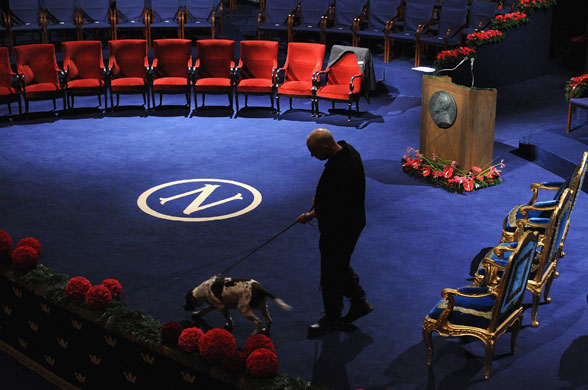
The Nobel Acceptance Speech


I have always wondered what it would be like to win the Nobel Prize for Literature. Forgive me - some writers get too ambitious! I wrote this piece as a fictional speech that would have to make if I ever won. Enjoy and critique!

The following is an official transcript of the Nobel acceptance speech given on Dec. 10, 20--:

Ladies and gentlemen, members of the press: I must say that I still feel as though I have been having a long and beautiful dream these last few months. Nothing can prepare the writer for the moment – a vivid point of realization - when he discovers that his chosen profession was not a mistake or a whim that would have been best left to adolescence. For that, I thank the academy. I thank you all.

If you will permit me, I will spend some time discussing my life as an artist and how it was possible for me to become a writer. In their time, William Faulkner spoke of the agony and the sweat of our labor; Camus meditated on his inability to live without art; and Rushdie analysed the actual construction of a book and what it could possibly reveal about its author. I will also attempt to use this moment for other things, knowing the import that this honour has for all of my fellow citizens - the first time our country has been so honoured in this field. First, there are themes that the critics have discovered in my work which need some comment. Then I will take a moment to discuss certain controversies that have followed me over the course of the last twenty years, such as the ones that you in the press may be more familiar with than necessary. My life and the details not present in the journals or newspapers announcing my receipt of this award will illuminate much that the critics have failed to reveal. Please bear with my garrulousness and excuse me for any confusion which may arise.

Critics spend their time mentioning that I often concern myself with the minutiae of life to the detriment of noticing the essentials of living in a fast and shape-shifting culture. I accept part of this critique, but I must mention how human beings work with sensations and change. We are all sensitive to these points of reference yet may not know how to understand them. Often, they are accepted or ignored and stored away in the mind. For me, the one thing that leads back to the memories of my childhood is peppermint. Yes, peppermint. We boiled the raw leaves that grew in our small garden and drank the tea as a family. I can even recall the cup my serving would be poured into, its dimensions and weight. And I would recall the mornings when drinking this brew would be a necessity against the cold that seemed a living creature outside the door, prowling in the neighbourhood. As a child, you may not think these memories exist to be recalled later in life, but artists are not allowed to forget. We always work with what others have forgotten, which brings me to another theme: the reference to the “missing figure” in my novels. Perhaps this is a fair observation. In “Straightjacket” and “So What About the Others?” there are male figures that do not perform their roles either due to absence or their own selfish behaviour. That may be a trope, or trap, that I cannot escape from when I move from one book to the next. Only my non-fiction, playwriting, and television work is seen as formless, which seems very odd. I make every effort to do my best and still entertain. Dear critics, please take a second look! (much laughter)

I mentioned controversies, so let me be brief with them. Some of the newspapers here and abroad mention my marriages and affairs as if they are all that matter, as though the books are the results of such things. I have finished a third marriage after ten years of what I considered bliss and met someone new with whom I can finally say that I feel a true love. And yes, she is an actress, just like the others. It may be that I am fulfilling a wish that I have long had to be a part of the limelight. The academy may be playing its part in that dream. (laughter)

Now, the main focus of my talk: the origin of the man you see before you. You could not piece together the ill-fitting sections of my life and arrived at a writer. My voice is just one of many that may have never been heard if it were not for a love of books, a love of creation. In my family, no one was intellectually adventurous. We owned an ancient dictionary, several bibles and an atlas. That was a book which I confess hypnotized me whenever I had a chance to open its heavy cover and explore. That made the act of reading more than visual to me. It made me desire to think of new ideas, new places. There was also the issue of never being read to as a young boy. No one ever stood between me and those few available books. My mother, bless her, would spend her rare free time singing to me or to no one but the space of the kitchen. This would wake me on Sunday mornings when we had to go to church and could expect a large breakfast after praying for our souls. With my father, things are on a different standing. I say are because I never feel as though I have escaped from what he was. We had a fine poet in my country who once wrote, “My father’s body was a globe of fear"; I would always have that image in my mind when thinking of him. He did not want to know me and seemed determined to remain unknown to me. There were humiliations, physical and mental assaults and verbal hectoring. Throttles, slaps, shoves and punches are not emotional, meaning that anyone can recover from them. It is what remains inside that suffers. A child begins to believe in his or her own lack of worth when no other opinion is ventured. My mother was never a participant or observer. She had no need to be. When she learned of these events, it was a difficult but important step in both our lives. We now knew each other beyond what most families allow themselves to feel. And when she passed away I mourned that I had not only lost a parent but also a friend who knew me well. Maybe I am still searching for that friend. (pause)

Finally, let me say that this Defoe accepts this award as recognition of all that I have done to make sure that my voice is heard and accepted by readers and especially the writers who are now taking those journeys into their imaginations and discovering all of the wonders that reside there. I hope that one day they will also have a chance to share this honour with me and the long line of dreamers who let their voices exist and grow on the page.
Once again, many thanks. (applause)

Sunday, September 6, 2009

How (Not) to Kill a Roommate


Some advice:
1. Usually, when sharing things with a roommate, certain sections of the refrigerator should be portioned off for your use and their use. If, for some reason, your roommate has forgotten which drink is his or how to make spaghetti sauce without using your vegetables, simply provide a strong electric current directly into the metal wiring of your shelf and leave several damp beer cans in clear view. This problem will solve itself.
2. An apartment can become quite dirty when a roommate forgets to take the time needed to pass a broom, mop, or vacuum cleaner over a carpet or uncovered floor. Encourage him to make it his business to keep things clean and tidy by reminding him of the potential for rats and roaches in an unkempt home. If this point remains unheeded, a small sampling of rats or roaches in, say, a knapsack, cereal box, or soap dish can bring this situation to an effective conclusion.
3. Everyone has a special cup or set of plates that are for use only on special occasions. Sometimes, a roommate can forget about your rule regarding usage and cleaning of certain glasses, china plates, and utensils. At such moments, it is not unwise to consider removing all of the dishes, cups, silverware, and the like which bears his name or is under the auspices of a family gift or heirloom. An added bonus here is that it provides more space for you in the drawers and cabinets.
4. Finally, there is the matter of dating. This is a sensitive issue that must be handled delicately in order that there are no red faces the next day. A special lady deserves to know just what your roommate is all about, as does the roommate’s girlfriend and parents. A handy list of previous encounters on index cards can provide an easy means of reference to likes, dislikes, and particular habits before the romance of the evening stalls without the presence of such a conversation piece. Of course, this can be created using the information taken from your roommate’s journal, parents and ex-girlfriends. It will give you all something to talk about in the weeks to come.

Friday, September 4, 2009

Internet Addiction and You, Me and Everyone else...


It was bound to happen.
I found a link to a news item that I should have expected. In the United States, the first Internet addiction center has opened. I had already heard a great deal about this on television and wondered if it was really the social problem that it is believed to be. In Asia, they have already opened centres to help out many addicted people. In fact, I once read a story about a man in a Korean café who died after more than two days at a terminal. No one noticed that he had passed away.
I type this as someone who uses their laptop and any other computer he can get his hands on almost every day. I don't play online games, but I understand their attraction. I once visited a café early one morning to send a few messages. I returned later in the day and noted that the same people were still there.
Perhaps this will be another field of addiction study, or a sociological phenomenon that we will soon be reading about in heavy tomes. Either way, it is a sign of the times we live in.
Let me know what you think!

Thursday, September 3, 2009

Parker's Blues (Part II)


The mention of personality, which is not the same as talent, must not overrule one central fact of the film: the casting is excellent. One simple measurement of their talent can be found in the ability to see these actors in work beyond monster-hunting in space. Tom Skeritt would go on to do work in other films and on television (notably Nash Bridges); Harry Dean Stanton, who was already a veteran on the Hollywood scene, is still one of America’s best character actors (we look for him even as he disappears into his role); John Hurt and Ian Holm were bred and trained under the British system of acting and can be relied on to surprise and attract an audience in any role; And then there is Sigourney Weaver, our Ripley, in her first important film role (she had a brief out-of-focus cameo in Annie Hall). Nothing earlier in the film leads us to believe that she will be the one to avoid the alien’s appetite and survive three sequels. It was truly her breakout role. Yaphet Kotto was also a veteran of the Hollywood scene. At that point, he had appeared in Across 110th Street, Live and Let Die and numerous other films. He would also appear on television on Homicide: Life on the Streets, earning an Emmy nomination for his portrayal of a police chief. In Alien, he is Parker, an engineer and a member of the repair crew responsible for keeping the ship running. He is also very self-involved and knows that he should be getting a better deal in regard to the “bonus situation”. This is the first sign - apart from the cigarettes - that this film has a cynical hole in its heart (Han Solo’s demands for payment is quickly resolved when he helps blow up the bad guys; Parker and Brett never get their fair share despite their work to get the ship running when the so-called skilled crew makes one of the worst ship landings in sci-fi film history). He speaks for all the working stiffs who help out behind the scenes when things are not going well; all guts and no glory.
Parker also seems to be forewarned of events about to take place. “Ifs” abound in this film and can be traced to his behaviour: If they had listened to him in regards to the mission, they would never have picked up the face-hugging alien; if they had listened to his idea of freezing Kane when he was attached to the creature, the thing about to burst out of his chest would have been someone else’s problem and several crew members would have lived if they had understood what it is he meant by saying that the “son-of-a-bitch is huge” instead of trying to chase it with flamethrowers in a narrow airshaft with faulty tracking equipment. The only possible hole in this theory is the death of Brett, the first member of the crew to succumb to the now full-grown monster. Parker, Ripley and Brett thought that they had the creature cornered. Instead, they almost snare Ripley’s cat, Jones. At Parker’s urging, and because it is his fault, Brett is sent off to find the cat and is killed. I would argue that if Brett were a little bit sharper, he would have survived. Why didn't he ask for backup when he discovered the shedded skin in the grate? And would anyone sensible still go on to look for a cat after seeing Kane’s gastrointestinal problems in the dining area? Brett’s death is his own stupid fault.
There are other dumb deaths in this film (Dallas’ end in a piece of duct work as he tries to hunt down the creature; Lambert’s frozen stance as she is being seduced to death), and it is necessary to include the punishment meted out to Parker. It is clear that Ridley Scott felt that he had given too much to Mr. Kotto as the film progressed and needed to have him die in a death scene that can still make one cringe every time one sees it or thinks about it.
Remember the scene: Lambert, Parker, and Ripley are the last survivors on the Nostromo and they have decided to fly off on the ship’s shuttle after setting the automatic self-destruct command on the ship. Lambert and Parker, while collecting extra canisters of oxygen for their journey, confront the beast. I mentioned Lambert being “seduced to death” and it is hard to argue with this theory. Consider how slowly the creature approaches her as she is rolling canisters across one of the decks. It is also significant that this is the first time the audience gets to see the top half of the creature’s body for longer than just a few frames. After chomping down on all of those men, a little bit of newly-acquired female flesh seems to be on the menu as Lambert is too paralyzed with fear to follow Parker’s command to move to the side as he prepares to barbecue it. But of course, this is just a trick to get Parker killed. The alien is fully aware that he is there and will do something to protect the one he loves (remember Ash’s fondness for the creature’s “purity” in its hostility, intelligence and lack of conscience). It is a relationship that Parker is trying to save, not just a crew member. Clearly, she and Parker have been involved with each other in some manner. It is just a question of piecing together what few clues there are to the relationships in the film. For instance, where are those two while Ripley discovers Ash’s true role as science officer? Out for a little stroll while a monster is hunting them down on board? Not likely. Parker’s lecherous comment that he’d “rather be eating something else” when Lambert’s scolds him for his dining habits displays something almost too subliminal: they were an item before any sort of mission to respond to a “distress signal” led to their deaths. She is trapped between two characters that both respond to her as a sex object and victim and Lambert and Parker both die in close quarters, the only time this occurs in the film. Also, Parker is the only one on the crew who engages with the monster in a one-on-one physical fight before his death. Yes, Ripley does manage to take it on once she is in a space suit and in close proximity to the air lock. But Parker is in a bare knuckle brawl with it, all the while trying to coax Lambert away from the scene for her own good. It would be worth applauding his efforts if it did not play up to the worst sort of stereotypes about black actors being killed off for the sake of their more “innocent” white compatriots. This is not necessary in a film that many have claimed to have broken new ground in the science-fiction/horror genre.
Mr. Yaphet Kotto, son of a Cameroonian crown prince and inspiration for at least one metal band, would not be saddled with this role as his only famous role (see earlier references to his other television and film work); this clearly shows how a talent can rise above the need to stereotype and pigeonhole actors in parts that limited them to a set of moods and responses. Still, it would have been nice if he had been given a better ending than just one as another black performer taking one for the team. He had the talent to deserve better than that.

Tuesday, September 1, 2009

Parker's Blues (Part I)


It is a strange time to be a fan of horror films. After September 11th, the media informed us that the age of irony (in American life, as has to be said) was over and that films would have to deal with cold facts and unpleasant truths in a manner supposedly unseen in recent American films. The press was apparently referring to the brilliant slew of films which arose in the shadow of the Vietnam War, the civil rights movement, hippies, recreational drug use, cults, the counterculture and Watergate. After almost three years after the fact, 9/11 is still firmly rooted in the psyche of the west, yet our films have not followed suit. We still have the blockbusters like Spider-Man, Transformers, and Fantastic Four in crowded cineplexes and Hollywood is pursuing a business-as-usual path. This is not to ignore some of the great “small” films that have gained notice in the press, such as American Splendor, Lost in Translation, Thirteen, and Saved! which have their own particular means of truth-telling or authenticity. They capture the obsessive nature of a culture and the need to see oneself as one actually is: ordinary, lost and unsure of where we stand.
But why horror films, exactly? In the best examples of that genre, they provide the same sort of mirror to their age as seen in so-called important movies. The nineteen-fifties introduced the sci-fi monster movie filled with nuclear accidents, uncontrollable experiments and a vision of places beyond the flatness of that decade’s conservatism. From this point, the jump to the seventies can only be explained through the drama of the decade that preceded it. The sixties – and by that term I mean the years between 1963 and 1975 – was filled with various changes and unforeseen upheavals that instantly dated the work of directors just a decade ago. Only Hitchcock and Roman Polanski captured the new sense of dread and unease in the west with films like Psycho, The Birds, Repulsion, and Rosemary’s Baby. Safe middle-class issues were now jettisoned; authority figures were challenged. The freedoms allowed on the screen would reach a strange peak with the first great possession films of the seventies The Exorcist and The Omen, two films rooted in the idea of an evil force that was recognizable and yet mysterious (everyone had their own notion of the Devil before those films cemented images in the mind). The Texas Chainsaw Massacre, one of the classics of a new genre known as the “slasher” film, introduced Leatherface, to be followed by Michael Myers (Halloween) and Jason (the Friday the 13th franchise). There was once again a recognizable evil, but one that did not appear to be based in religion or myth. It came straight from the culture which wanted to see its own fears and dread placed on the silver screen.
This brings us to Alien, which closed the decade on a note of low optimism as to what to expect from other imagined worlds. The contrast with Close Encounters of the Third Kind and Star Wars was sharp and unforgiving. Steven Spielberg and George Lucas wanted to imagine the best of several worlds and to portray a faith in extraterrestrials as agents of benevolent change. Ridley Scott brought home the nightmare that was a part of the experience of watching the monster films of the fifties and tied it into the paranoia and excess of his time.
It is still a great film, despite all of the reassessments which have taken place since its re-release in theatres after twenty-four years (an odd time for celebrating its anniversary). Critics who watched the first release were correct in referring to the scarceness of background information on the characters and the problem of believing in the manner in which they attempt to hunt the monster. One interesting review made a point of complaining about the unnecessary amount of drool released by the monster and how it was actually searching for a bib when it began to feast on the ship’s crew. These issues may not be in the layman’s mind when first seeing the film as all of the attention is consumed by the claustrophobic set design, disturbing music score and the visual effects which are still worth mentioning. The alien, created by German artist H R Giger, was made using actual bones and with the intention that it would seem to be more suited to that cramped ship than any of the other humans on board (and lacking in a personality, it is an ideal match). When looking through all of the players, personality seems to go only halfway with any of them. As mentioned earlier, a lack of background detail is quite frustrating while watching the film. It is only through spare comments and quick recognition of certain relationships that the viewer learns anything about these people as they return from a cargo haul on board the Nostromo. This is why the character of Parker becomes more striking after repeated viewings. He is the only one on board who seems driven and determined to be himself with a personality uniquely his own. We should be rooting for him to survive.