
Monday, May 31, 2010
A Writing Life (Part 12)


Sunday, May 30, 2010
A Writing Life (Part 11)

*
I should talk about other inspirations, namely the books that I read or were exposed to by other readers. It is impossible to remember the first ones who read to you, or their stories, but I know that it was my mother. There were stories from the Bible and picture books that I recall from sitting on her lap and listening. In school, I read many of the same stories and others that interested me. There was also Mrs. Miller, the elementary school librarian, a tall and thin woman with a short haircut who spoke in soft tones, even when she was chastising us. I will never forget those close gatherings in the library, sitting with my classmates as she shared another storybook with us.
Saturday, May 29, 2010
A Writing Life (Part 10)

The reason why the idea of a writing life lingered in my mind was because of a kind woman in my high school who decided to organize its first writing club. Her name now escapes me (I do not have any of my high school yearbooks with me as I write), but I remember her as a heavy woman in glasses who always smiled. The rest of the group were students I had never met, except for one friend who came and told stories about being in the cadets and having to hike with a full kit for hours in the wilderness. Soon, this group dwindled down to just me and this woman. She was the one who got me into the habit of carrying around a pen and paper to save whatever thoughts came to me (she gave each of us a cheap spiral notepad at our first meeting). Because I was the only one left, I became the president of the club. I did not always have stories written down, but the meetings gave me an opportunity to share what had happened in my life with a stranger (this is what the best writing should do). This club lasted for the length of my final year at school and I won an award for leadership because of it. I do not know if the club continued after I graduated.
Thursday, May 27, 2010
A Writing Life (Part 9)

Wednesday, May 26, 2010
A Writing Life (Part 8)

There were many poems written, performed and put into campus journals. I also wrote occasional articles for the campus newspaper, became Social Co-Ordinator of the Humanities in my senior year, read and studied the masters of English literature and finally felt comfortable with my education. I even wrote two plays and managed to have one of them performed on campus in the student art museum. I had finally found what I was supposed to be doing with myself.
*
Tuesday, May 25, 2010
A Writing Life (Part 7)

I mentioned that my interest in science was partly inspired by my perception of what it meant to be a scientist. The other influence did come from school. From the moment we were about to graduate from the elementary level, we were put into different streams of academic ability (the levels were called Basic, General and Advanced). I somehow made it into the Advanced stream. I really do not know why. My grades in the courses unrelated to science (History, French, Art, and especially English) were quite good. It was mathematics and science that tripped me up. And yet, I was put into that advanced group before entering high school. We had different math books, different assignments, even different equipment (it was the first time I needed a programmable calculator). It added to the sea of confusion I found myself in, and no one could tell that I was drowning.
High school added confusion to confusion. I could not focus on the homework in my science classes and the math seemed to be written in a foreign language (in its own way this is true). But I persevered, even going so far as to cheat on an aptitude test (the test was given during a chemistry class; a nice touch, I thought). Up to my first year at university, I had it in mind that I was supposed to be in science (it became computer science). And then I simply had enough. I left the major I found myself with and took a different route at another school. This is why I now have a master’s degree from one of the oldest universities in the country and no regrets about the decision to change my field of study. This is why I would encourage anyone who asks to study what they love, not the material thought to lead to some sort of job in a murky future.
Saturday, May 22, 2010
A Writing Life (Part 6)

So, there are two blank spaces in my life. This, as I said, was an advantage. I began to write without thinking that I had to sound like anyone else I read. I still have the first poem I ever wrote for my own pleasure. There were assignments and school books that my mother saved (these do not count; they belong to the particular environment of my grade school, not my home). I was fourteen or fifteen (probably the latter) and had a small notepad. I had not yet gotten into the habit of carrying around something to write in when I went out, so I know that I wrote this in my room. It was about a prince in his kingdom observing his world and his life. I will not quote the poem here, except for an interesting simile about the movement of dancers “like drunken scarecrows.” I still like that comparison and am glad that I came up with it as a teenager. I just wish I knew why I wrote it. I had no intention of being a writer, especially a poet. My plan was to study science and become a scientist of some sort. I had even gone as far as to tell my mother that I would not have time for my guitar with all of the school work I expected to have. None of this proved to be true. The bug had bitten.
*
I now wonder if schools can ever encourage good writing. My interest in science was partly inspired by the misconceptions I had about what being scientist meant. I watched science programs (one called “Don’t Ask Me” was a favorite) and science-fiction movies and television programs. No one in my family was a scientist. No one I knew had even graduated from university or college (my mother had to come to Canada to get her high school diploma). But I really felt that I could be a scientist. I remember reading a comic book once and discovering the line “the smooth purity of science.” I liked that phrase and kept it in mind whenever I had difficulties with a school project or assignment. It was what I wanted from my school.
Thursday, May 20, 2010
A Writing Life (Part 5)

I take no pleasure in looking back at that moment, not just as a reader but as an aspiring writer attempting to create a vision on paper. I did not read about anyone I could recognize as someone in my own family or community when I went to Canadian literature (I had to read books from England, the USA and older Russian novels for such work). I did not see our society in the canon of the country’s “best” writing. This should have been expected. I once read a guide to historical literary sites in Canada and there was not a single mention of anyone in a community I could recognize. There was not even a mention of the hometown I lived in. It was as if we had never really existed in the cultural life of the nation.
This has its advantages. It is only recently that I have realized how lucky I was to come out of two separate environments: my hometown, which had never produced a great writer or artist beyond comedians and pop musicians; and my family and their roots in the Caribbean. With the former, there is no literary history. What history existed there never received a comment in the textbooks we used at school or in the media that attempted to cover the stories of the entire nation. With the latter, the sense of history began and ended with an idea of slavery that was vague and island culture. Everything else had to be filled in by my imagination. To me, my mother’s family only existed as far back as her grandmother. I still have not met most of my uncles and aunts – one aunt died and I could not make it to the funeral. My father’s family history is even more obscure. He died when I was ten years old and I never had the chance to really ask him about his life. I never learned anything about his father. His mother was, from what little I learned, a vicious woman who abused him so badly as a child that he still had the physical scars on his body as an adult. That was all I knew about their lives before they immigrated to Canada, besides the information contained in photographs and the few books that dealt with the history of that small area of land they called home. Like my family, I strived to find anything I could about my culture and the island. I even videotaped a television series based on a novel set there (we never really watched it, although the tape is still on a shelf in our basement). I grew up only half-knowing where I came from. I had to create an identity.
Wednesday, May 19, 2010
A Writing Life (Part 4)

That was one extreme moment of many experiences (it was only for two summers and I often worked in the back offices on different floors). But I began to imagine things about the patrons. At another library, I once waited early one morning for the doors to open. I was surrounded by other patrons and could easily categorize them: homeless, retiree, unemployed, student, housewife, etc. They each gave away an idea of themselves that I now perceive with others without being too aware of what I am doing: the street tan of a homeless man; the loudness and exaggerations of students; the shy body language of married people. It all became real and clear.
*
I began this by describing what I saw when I first sat down to write. This does matter and is worth recreating on the page. Vividness in writing is what we should look for, along with an honest picture of our time. Most of the writing that disappoints me fails to do either of these things. Many recent Canadian novels have taken a particular historical moment and created a plot around it. I understand the need to recall our history in our arts, but the books are limited and are due to be forgotten, despite any and all of the media interest, awards and sales figures. They are commenting well after the fact (it would be a great challenge for these types of writers to honestly describe what it feels like for a modern Canadian to wait in line for the bus on a cold day). They simply cannot look at the world we live in and tell us about it. The other type of writing refutes these historical narratives. The authors make a very determined attempt to talk about life as it is lived. This is to be commended. The problem here is that the books usually do not retain our interest. The plots are either uninspired or clichéd; the characters remain flat and soon become forgettable; and the reader is soon convinced that this is the way the novel should be written (no one wants to admit that the emperor has no clothes). I remember the moment when I came to this conclusion. I was, appropriately enough, working in a bookstore and had just bought a book that was a bestseller, one that was praised, if I remember correctly, as “a gem of a novel.” I sat in a café, read a few pages, and then shut the book. I tried to re-read those pages after reading another full-length review in a national newspaper that once again praised it. I, once again, closed the book after reading the first few pages. I did not open it again. It left a bad sensation in my mind and I noted how many other best sellers and critical favorites left me feeling disappointed and cheated.
Thursday, May 13, 2010
A Writing Life (Part 3)

From this stool seat, I have a view of a street thick with snow, a Japanese restaurant on the corner with two wreaths hung under two banners proclaiming offers of SUSHI and NOUILLES. The rest of this and some other buildings are in red brick (quite beautiful in the bright sunlight, silhouetted against the untouched blue sky). There are four bare grey trees, a wired pole (telephone line, perhaps), black traffic light poles, a fire hydrant, a few bicycles, no cars (on this section of the street) and the light blue shade of the building I am sitting in just cutting across the road at an angle and touching the opposite curb. These things matter. I cannot see most of the other patrons here as I write and I have brought my portable music player with me. All I can see in front of me is the pen, the notebook, a cup of coffee and the outdoors.
Where I write is also quite important. Coffee shops are always easy to work in. Coffee – the best kind – is full of caffeine and bitterness. The best way for me to get any work done is to have a hit with no sugar (just a little cream or milk) and then write. I have completed more letters and assignments in rough this way. Where I cannot work is in any environment where the idea of writing is an established part of the scenery (e.g. a library). You should never try to write anything too creative in a library. There is a reason why painters do not work in galleries, or why butchers do not take their pets with them to work. Writing in a library, to me, is like painting in a museum. The environment is a too-powerful reminder of what you are trying to achieve. It can intimidate you out of the work you are trying to complete. At best, the library, like any site of human traffic, should be a source of inspiration. I have had experiences in a library that I have never had anywhere else. I have been hit on indirectly as I sat studying (a friend of the girl who spoke to me said that she thought I was cute). I have read notes left behind or in books that were intimate and embarrassing. I have overheard conversations that I never expected to hear. The worst and most vivid of these moments came when I worked one summer at the central branch of the library in my hometown. There was an old man in glasses and a hat who used to sit at a large table by himself with various magazines and newspapers. As he read, he would mutter something quietly to himself in a language that I could not place. When I asked a security guard about him, she told me that he was there almost every day. She could also understand what he was saying (they were both Polish): it was something about putting baby heads on spikes. That was all he repeated to himself, day after day.
Wednesday, May 12, 2010
A Writing Life (Part 2)

I said, “Begin to write.” It is hard to say how I finish. I always try to begin in longhand with a notebook; rarely with loose sheets of paper or a pad (they seem to be only for students taking notes or people writing out letters). I have only written a few things directly on a keyboard: a brief film script for a friend’s project; some letters, résumés and poems that are not worth remembering or repeating. A blank page waiting for the ink or graphite marks of my thoughts is a pleasure that many writers consider a form of torture. But you can never really get away from that expanse of clean space. As I write this, I am surrounded by many other patrons trying to write. And they are almost all on personal laptop computers. This would be nothing but a distraction for me (email, games online and on the hard drive, adjusting files and images, etc.) I recommend leaving the technology at home and facing that space with something less electronic and sophisticated.
I use a Pilot Fineliner in black to write these kinds of essays. Also, I have mechanical pencils and a knockoff slick blue ink pen from a chain store (something called an OptiFlow). This is important to me. I never use ballpoint pens and have only recently returned to using any type of pencil. I don’t consider any of this odd or out of touch with technological advances in writing. I still use a computer and I try to complete what I have written up for the day onto a specific file. This is just one stage out of many involved in this type of work.
Tuesday, May 11, 2010
A Writing Life (Part I)
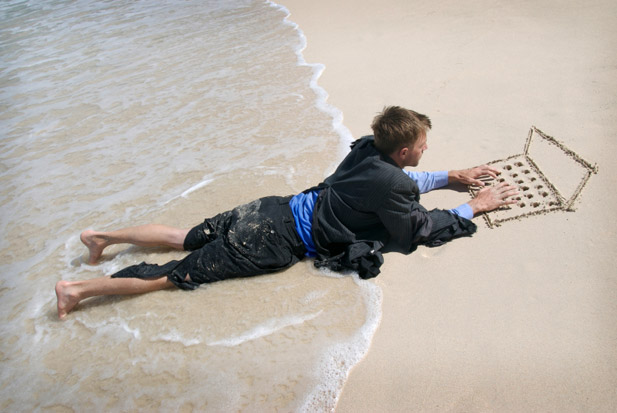
I have written the following long piece out and, following a friend's advice, I have decided to break it down into short pieces and post the results here. It is just an honest attempt to talk about what I do when I write and some of the history behind why I do this (a little dated, but it gets to the point):
A Writing Life
It is the first truly cold day of the year and I am in a coffee shop with a letter from another magazine reminding me of their contests. I have been carrying around this dollar-store notebook without putting down a single word. I have also carried around a second smaller notebook with perforated sheets that are easily torn out for notes. In this notebook, I have saved up many ideas that have not yet been followed through in full essays or stories. This is the more important of the two books. It provides a clear guide to my mind’s travels and sometimes nonsensical thoughts. I could not work without it. It gives me the push to write more than just a memo to myself. This is how I begin to write.
Subscribe to:
Comments (Atom)